Inquire: Call 0086-755-23203480, or reach out via the form below/your sales contact to discuss our design, manufacturing, and assembly capabilities.
Quote: Email your PCB files to Sales@pcbsync.com (Preferred for large files) or submit online. We will contact you promptly. Please ensure your email is correct.
Notes: For PCB fabrication, we require PCB design file in Gerber RS-274X format (most preferred), *.PCB/DDB (Protel, inform your program version) format or *.BRD (Eagle) format. For PCB assembly, we require PCB design file in above mentioned format, drilling file and BOM. Click to download BOM template To avoid file missing, please include all files into one folder and compress it into .zip or .rar format.
As a PCB engineer who’s spent years wrestling with high-density designs, I can tell you that choosing the right layer count is one of the most critical decisions you’ll make in any project. When your design demands serious routing density, rock-solid signal integrity, and bulletproof EMI performance, a 12 layer PCB often becomes your best friend.
In this guide, I’ll walk you through everything you need to know about 12 layer PCB design, from stackup configurations to real-world applications and the nitty-gritty of manufacturing. Whether you’re spec’ing out a new aerospace project or designing next-gen telecom equipment, this comprehensive breakdown will help you make informed decisions.
12-Layer PCB Stackup Selector
12-Layer PCB Stackup Selector 12L
Configure layer thicknesses for complex 12-layer HDI and high-speed PCB designs
Quick Presets
Layer Assignment (SIG-GND-SIG-PWR Pattern)
L1 SIG
L2 GND
L3 SIG
L4 PWR
L5 SIG
L6 GND
L7 PWR
L8 SIG
L9 GND
L10 SIG
L11 PWR
L12 SIG
Copper Layers (12)
Prepreg Layers (6)
Core Layers (5)
Total Board Thickness
2.000mm
2000 µm
vs 2.0mm
+0 µm
Copper (12L)
420 µm
Prepreg (6L)
826 µm
Core (5L)
800 µm
Stackup Visualization
SOLDER MASK (TOP)
L1 – Top SignalSIG35µm
PP1114µm
L2 – GND PlaneGND35µm
Core 1100µm
L3 – SignalSIG35µm
PP2114µm
L4 – PWR PlanePWR35µm
Core 2200µm
L5 – SignalSIG35µm
PP3185µm
L6 – GND PlaneGND35µm
Core 3 (Center)200µm
L7 – PWR PlanePWR35µm
PP4185µm
L8 – SignalSIG35µm
Core 4200µm
L9 – GND PlaneGND35µm
PP5114µm
L10 – SignalSIG35µm
Core 5100µm
L11 – PWR PlanePWR35µm
PP6114µm
L12 – Bottom SignalSIG35µm
SOLDER MASK (BOTTOM)
Outer Signal
Inner Signal
GND Plane
PWR Plane
Prepreg
Core
💡 Common 12-Layer Targets
1.6mm: High-density HDI designs 2.0mm: Standard 12L (most common) 2.4mm: Server, networking 3.0-3.2mm: Backplanes, heavy copper
6 Signal Layers: L1, L3, L5, L8, L10, L12 — Maximum routing density with 4 protected stripline layers. 3 GND Planes: L2, L6, L9 — Distributed ground reference minimizes return path inductance. 3 PWR Planes: L4, L7, L11 — Multiple power domains with L6-L7 forming a low-inductance decoupling pair. Symmetry: Structure is symmetric about center for optimal warpage control during reflow.
What Is a 12 Layer PCB?
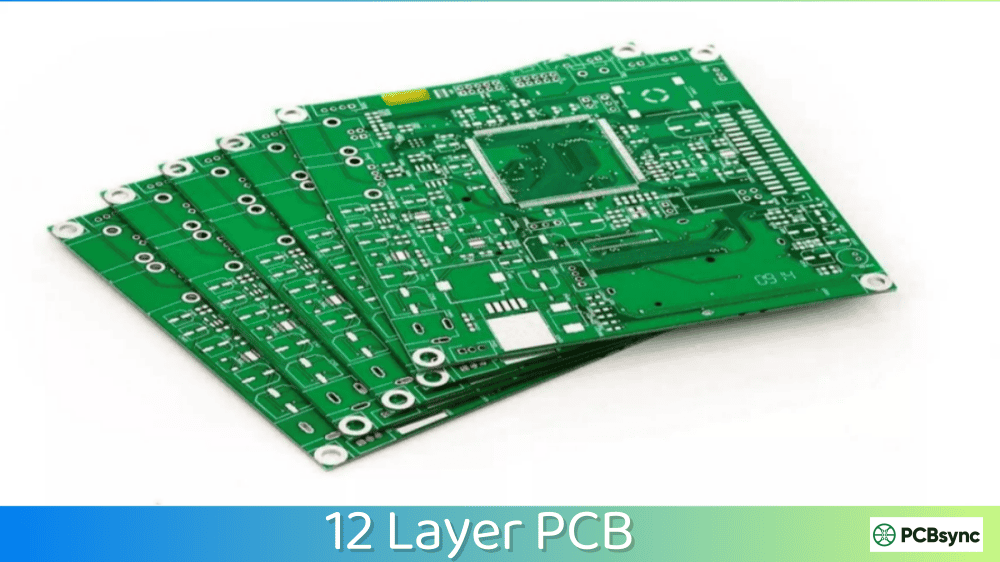
A 12 layer PCB is a multilayer printed circuit board containing twelve conductive copper layers separated by insulating dielectric materials. Think of it as a carefully engineered sandwich where each layer serves a specific purpose—signal routing, power distribution, or ground reference planes.
Unlike simpler 4-layer or 6-layer boards, a 12 layer PCB gives you the routing real estate and signal isolation needed for complex, high-speed designs. You’re essentially getting twelve distinct copper planes to work with, typically organized as a combination of signal layers, power planes, and ground planes.
The basic composition includes:
Component
Description
Typical Quantity in 12 Layer PCB
Copper Layers
Conductive material for signal traces and planes
12 layers
Prepreg Layers
Semi-cured resin-impregnated fiberglass for bonding
6 layers
Core Layers
Fully cured dielectric with copper on both sides
5 cores
Solder Mask
Protective coating on outer surfaces
2 layers (top/bottom)
What makes the 12 layer configuration particularly valuable is its ability to dedicate specific layers to specific functions. You can route high-speed differential pairs on shielded inner layers while keeping power distribution completely separate from your sensitive signal paths.
Understanding the physical structure of a 12 layer PCB is essential before diving into stackup design. Each component plays a critical role in the board’s electrical and mechanical performance.
Core Materials
The core serves as the structural backbone of your PCB. It’s a fully cured laminate with copper foil bonded to both sides. In a 12 layer design, you’ll typically use five cores of varying thicknesses depending on your impedance and overall board thickness requirements.
For most multilayer PCB applications, high-Tg FR-4 (Tg170) is the go-to choice. It handles the thermal stress of lead-free soldering without delamination issues that can plague standard FR-4 in high-layer-count boards.
Prepreg Layers
Prepreg (pre-impregnated) material is the glue that holds your stackup together. It’s fiberglass cloth impregnated with partially cured resin that flows and bonds during the lamination process.
The three most common prepreg types you’ll encounter:
Prepreg Type
Nominal Thickness
Resin Content
Usage Notes
7628
7.5 mils (0.19mm)
Lower
Gap filling, thicker dielectric
2116
4.5 mils (0.11mm)
Medium
Standard applications
1080
3.0 mils (0.08mm)
Higher
Thin dielectric, tight coupling
Copper Foil Weights
Copper thickness directly impacts current-carrying capacity and trace impedance. Standard 12 layer PCB designs use 1 oz (35μm) copper on all layers, but your power distribution requirements might dictate heavier copper on specific planes.
Copper Weight
Thickness
Typical Application
0.5 oz
17.5 μm
Fine-pitch routing, HDI
1 oz
35 μm
Standard signal and plane layers
2 oz
70 μm
High-current power planes
3 oz
105 μm
Heavy power distribution
12 Layer PCB Stackup Design Principles
Getting your stackup right is arguably the most important aspect of 12 layer PCB design. A well-planned stackup sets you up for success in signal integrity, EMC compliance, and manufacturability. A poorly planned one creates headaches that no amount of routing finesse can fix.
Layer Assignment Strategy
In a 12 layer board, you’ve got flexibility in how you assign layer functions. The general principle is straightforward: every signal layer should have an adjacent reference plane (ground or power) for proper return current paths and controlled impedance.
Here’s a proven layer assignment approach that I’ve used successfully across dozens of designs:
Layer
Function
Notes
L1
Signal (Top)
Component side, high-density routing
L2
Ground Plane
Reference for L1 and L3
L3
Signal
High-speed routing, stripline
L4
Power Plane
Tightly coupled to L5 ground
L5
Ground Plane
Forms low-inductance power/ground pair
L6
Signal
Mixed signal routing
L7
Signal
Mixed signal routing
L8
Ground Plane
Reference for L6 and L7
L9
Power Plane
Secondary voltage rails
L10
Signal
High-speed routing, stripline
L11
Ground Plane
Reference for L10 and L12
L12
Signal (Bottom)
Component side, high-density routing
This configuration provides ground planes adjacent to every signal layer, ensuring clean return paths and excellent EMI performance.
The industry has settled on several proven stackup configurations for 12 layer PCBs. Your choice depends primarily on your total board thickness requirement and the number of signal layers you need.
Standard 1.6mm 12 Layer Stackup:
Layer
Type
Copper
Dielectric to Next Layer
L1
Signal
1 oz
4 mil prepreg (1080)
L2
Ground
1 oz
5 mil core
L3
Signal
1 oz
4 mil prepreg (2116)
L4
Power
1 oz
5 mil core
L5
Ground
1 oz
4 mil prepreg (1080)
L6
Signal
1 oz
5 mil core
L7
Signal
1 oz
4 mil prepreg (1080)
L8
Ground
1 oz
5 mil core
L9
Power
1 oz
4 mil prepreg (2116)
L10
Signal
1 oz
5 mil core
L11
Ground
1 oz
4 mil prepreg (1080)
L12
Signal
1 oz
—
Standard 2.0mm 12 Layer Stackup:
For designs requiring thicker boards—perhaps for mechanical rigidity or connector specifications—a 2.0mm stackup uses slightly thicker cores and prepreg layers while maintaining the same layer functions.
Impedance Control Considerations
High-speed designs live and die by impedance control. In a 12 layer PCB, you’ll typically target:
Signal Type
Target Impedance
Typical Implementation
Single-ended
50Ω
Microstrip on outer layers, stripline on inner
Differential pairs
100Ω differential
Edge-coupled pairs with ground reference
DDR4 signals
40Ω single-ended
Matched impedance throughout routing
USB 3.0/3.1
90Ω differential
Tightly coupled differential pairs
The key to hitting your impedance targets is controlling three variables: trace width, dielectric thickness, and dielectric constant. Work closely with your fab house during stackup planning—they can tweak prepreg selections and copper weights to hit your numbers.
Signal Integrity and Power Integrity in 12 Layer PCB
One of the primary reasons engineers choose a 12 layer PCB is the superior signal integrity (SI) and power integrity (PI) it enables. With more layers to work with, you can implement proper return paths, minimize crosstalk, and create robust power distribution networks.
Signal Integrity Best Practices
Crosstalk is your enemy in any high-speed design. In a 12 layer board, you have the luxury of dedicating ground planes between signal layers, which dramatically reduces layer-to-layer coupling. But you still need to manage same-layer crosstalk through proper trace spacing.
Key signal integrity rules for 12 layer designs:
Parameter
Guideline
Impact
Trace-to-trace spacing
Minimum 3x trace width
Reduces crosstalk
Via stub length
<10 mils for >5 GHz signals
Prevents resonance
Reference plane gaps
Route around, never cross
Maintains return path integrity
Layer transitions
Minimize via count
Reduces impedance discontinuities
Power Distribution Network Design
A 12 layer PCB gives you the planes you need for a solid power distribution network (PDN). The key is creating tightly coupled power-ground plane pairs that act as embedded capacitance, reducing the need for decoupling capacitors and improving transient response.
Place your power and ground planes on adjacent layers separated by thin dielectric (3-4 mils). This creates significant plane capacitance—typically 50-100 pF per square inch—that helps suppress power supply noise in the 100 MHz to 1 GHz range.
EMI/EMC Performance
The multiple ground planes in a 12 layer PCB provide natural EMI shielding. By routing sensitive signals on buried layers between ground planes, you create a Faraday cage effect that contains electromagnetic fields within the board structure.
This configuration typically achieves 15-20 dB better EMI performance compared to a 4-layer board with similar routing density. For products requiring FCC Class B or CISPR 32 compliance, this can mean the difference between passing and failing on the first test cycle.
12 Layer PCB Applications Across Industries
The complexity and cost of 12 layer PCBs mean they’re reserved for applications where the benefits justify the investment. Here’s where you’ll find them deployed across various industries.
Telecommunications and Networking
The telecom industry is probably the biggest consumer of 12 layer PCBs. Network switches, routers, 5G base stations, and satellite communication equipment all demand the routing density and signal integrity that 12 layers provide.
Common telecom applications:
Equipment Type
Why 12 Layers?
5G Base Stations
High-frequency signal routing, multiple antenna feeds
Core Routers
Dense BGA breakout, high-speed serial interfaces
Network Switches
Multiple 25G/100G SerDes channels
Optical Transceivers
Precise impedance control for high-speed data
Aerospace and Defense
Aerospace applications demand the reliability and performance that 12 layer construction enables. Avionics systems, satellite electronics, and radar systems all benefit from the enhanced EMI shielding and signal isolation.
These applications often require operation across extreme temperature ranges (-55°C to +125°C), making material selection critical. High-Tg laminates and polyimide-based materials are common choices for aerospace 12 layer boards.
Medical Electronics
Medical imaging systems—CT scanners, MRI machines, ultrasound equipment—rely on 12 layer PCBs for their signal processing boards. The precision required for diagnostic accuracy demands clean signal paths and minimal noise, which proper 12 layer design delivers.
High-Performance Computing
Data center servers, GPU accelerators, AI training systems, and high-performance computing platforms all leverage 12 layer PCBs. The dense BGA breakout requirements of modern processors (think thousands of pins on a single device) simply can’t be met with lower layer counts.
Computing Application
Key Design Challenges
Server Motherboards
DDR5 routing, PCIe Gen5 channels
GPU Cards
Memory interface routing, power delivery
AI Accelerators
High-bandwidth memory (HBM) integration
Network Interface Cards
400G Ethernet SerDes
Automotive Electronics
The automotive industry’s shift toward electric vehicles and autonomous driving has created massive demand for sophisticated electronics. Advanced Driver Assistance Systems (ADAS), battery management systems, and infotainment units increasingly require 12 layer PCBs.
Automotive applications add environmental challenges—vibration, temperature cycling, humidity—that influence stackup and material choices. Most automotive 12 layer designs use high-Tg materials certified to AEC-Q100 standards.
12 Layer PCB Manufacturing Process
Understanding the PCB manufacturing process helps you design boards that are both manufacturable and cost-effective. The 12 layer fabrication sequence is significantly more complex than lower layer counts.
Manufacturing Workflow Overview
Step
Process
Critical Parameters
1
Design Input
Gerber files, drill data, stackup specification
2
Inner Layer Imaging
Photolithography, pattern transfer
3
Inner Layer Etching
Copper removal, trace definition
4
AOI Inspection
Automated defect detection
5
Oxide Treatment
Surface preparation for bonding
6
Layup
Core and prepreg stacking
7
Lamination
Heat and pressure bonding
8
Drilling
Mechanical and/or laser drilling
9
Electroless Copper
Via metallization
10
Electroplating
Copper buildup
11
Outer Layer Imaging
Pattern transfer
12
Outer Layer Etching
Final trace definition
13
Solder Mask
Protective coating
14
Surface Finish
ENIG, HASL, OSP, etc.
15
Electrical Test
Continuity and isolation
16
Final Inspection
Visual and dimensional
Layer Registration Challenges
The biggest manufacturing challenge with 12 layer PCBs is maintaining layer-to-layer registration throughout the lamination process. Material expansion during the high-temperature lamination cycle can cause layers to shift relative to each other.
Modern fabricators achieve registration tolerances of ±50μm (2 mils) or better through:
X-ray hole calibration during drilling
Real-time temperature and pressure monitoring during lamination
Optical alignment systems during layup
Statistical process control across production lots
Via Technology Options
A 12 layer PCB can utilize various via types depending on routing density requirements:
Via Type
Description
Application
Through-Hole
Drills through all 12 layers
Standard interconnects
Blind Via
Connects outer layer to inner layer
HDI designs, BGA breakout
Buried Via
Connects inner layers only
High-density routing
Stacked Via
Multiple vias aligned vertically
Maximum density
Staggered Via
Offset vias for reliability
High-reliability applications
Blind and buried vias require sequential lamination, adding cost and lead time but enabling routing densities that through-hole-only designs can’t achieve.
Quality Control and Testing
Quality control for 12 layer PCBs is more rigorous than simpler boards due to the higher stakes involved. Standard testing includes:
Electrical Testing: Flying probe or bed-of-nails testing verifies continuity and isolation across all nets. For complex boards, test times can exceed 30 minutes per panel.
Impedance Testing: Coupon testing with Time Domain Reflectometry (TDR) validates that controlled impedance traces meet specifications, typically within ±10%.
Cross-Section Analysis: Microsectioning of coupons verifies copper thickness, dielectric thickness, via quality, and layer registration.
X-Ray Inspection: Automated X-ray systems check via fill quality and internal layer alignment on sample boards.
Design Considerations and Best Practices
After designing numerous 12 layer boards, I’ve compiled the practices that consistently lead to successful designs.
Design for Manufacturability (DFM)
Work with your fabricator early in the design process. Share your stackup concept before finalizing it—they can identify potential issues and suggest optimizations based on their process capabilities.
DFM Parameter
Typical Capability
Notes
Minimum trace width
3-4 mils
Tighter requires HDI process
Minimum trace spacing
3-4 mils
Match to trace width
Minimum via diameter
8 mils (0.2mm)
Smaller requires laser drilling
Aspect ratio
10:1 maximum
Via depth to diameter
Annular ring
4 mils minimum
Pad-to-hole clearance
Thermal Management Strategies
High-power components on 12 layer boards need careful thermal planning. The multiple copper planes actually work in your favor here—copper’s thermal conductivity helps spread heat across the board.
Effective thermal management techniques:
Use thermal vias under power components (arrays of small vias connecting to internal copper planes)
Avoid thermal relief on power pads for high-power devices when possible
Consider heavier copper (2 oz) on power planes if heat dissipation is critical
Add copper pours on signal layers in unused areas to improve thermal spreading
Cost Optimization Tips
12 layer PCBs aren’t cheap, but smart design choices can keep costs reasonable:
Stick to standard thicknesses (1.6mm, 2.0mm) when possible—non-standard stackups require engineering time and setup charges
Minimize via types—a design using only through-hole vias costs significantly less than one requiring blind/buried vias
Use standard copper weights (1 oz) unless your design truly requires heavier copper
Panel utilization matters—work with your fab to maximize the number of boards per panel
Avoid exotic materials unless your application genuinely requires them—standard high-Tg FR-4 handles most applications
12 Layer PCB vs. Other Layer Counts
When should you choose a 12 layer PCB over other options? Here’s a practical comparison to guide your decision:
Factor
8 Layer
10 Layer
12 Layer
14+ Layer
Routing Layers
4
6
6-8
8+
Plane Layers
4
4
4-6
6+
Relative Cost
1x
1.3x
1.6x
2x+
Lead Time
Standard
Standard
+2-3 days
+5-7 days
EMI Performance
Good
Better
Excellent
Excellent
BGA Breakout
Limited
Moderate
Good
Best
Choose 12 layers when:
Your design has more than 2,000 nets
You’re routing DDR4/DDR5 memory interfaces
Multiple high-speed serial interfaces (PCIe, USB, Ethernet) are present
EMC compliance is critical and design cycle time is limited
BGA devices with pitch ≤0.8mm need routing
Stick with 8-10 layers when:
Net count is under 1,500
Signal speeds are moderate (under 5 Gbps)
Cost is the primary driver
Standard BGA pitches (1.0mm+) are used
Useful Resources for 12 Layer PCB Design
Here are resources I regularly reference when working on 12 layer designs:
Design Guidelines and Standards
Resource
Description
Link/Access
IPC-2221B
Generic PCB Design Standard
IPC Association
IPC-2141A
Controlled Impedance Design
IPC Association
IPC-4101E
Laminate Specification
IPC Association
IPC-6012E
Rigid PCB Qualification
IPC Association
Design Tools and Calculators
Tool
Purpose
Availability
Saturn PCB Toolkit
Impedance, via current, trace width calculations
Free download
Altium Designer Stackup Planner
Interactive stackup design
Included with Altium
Polar Si9000
Professional impedance modeling
Commercial license
KiCad Stackup Editor
Open-source stackup planning
Free, open-source
Material Datasheets
Always reference manufacturer datasheets for accurate dielectric constant and loss tangent values:
The most common thickness for a 12 layer PCB is 1.6mm (0.063″), which is the industry standard that fits most connector and enclosure specifications. However, thicknesses of 2.0mm, 2.4mm, and even 3.0mm are available when designs require additional mechanical strength or thicker dielectric layers for specific impedance targets. The final thickness depends on your copper weights, prepreg selections, and core thicknesses—work with your fabricator to hit your target while maintaining a symmetric stackup.
How much does a 12 layer PCB cost compared to lower layer counts?
As a rough guideline, a 12 layer PCB costs approximately 1.5-2x what an 8 layer board of the same size costs. The exact multiplier depends on several factors: board size, quantity, material selection, via types required, and surface finish. Adding blind or buried vias can increase costs by another 30-50% due to the sequential lamination required. For prototype quantities (under 10 pieces), expect to pay $200-500 per board for standard complexity designs. Production volumes see significant price reductions.
When should I use a 12 layer PCB instead of 10 or 14 layers?
Choose 12 layers when your routing analysis shows you need 6-8 signal routing layers and 4-6 reference planes, but can’t quite fit everything on 10 layers. The 12 layer configuration hits a sweet spot for complex digital designs with multiple high-speed interfaces. If you find yourself constrained even with 12 layers—perhaps due to extremely dense BGAs or many high-speed channels—step up to 14 layers. Conversely, if routing completes comfortably on 10 layers during your preliminary layout, stick with 10 to save cost.
What materials are recommended for high-frequency 12 layer PCB designs?
For designs operating above 3 GHz, standard FR-4’s relatively high dielectric loss becomes problematic. Consider mid-tier materials like Isola I-Tera MT40 or Rogers RO4350B, which offer lower loss tangent (Df < 0.004) while remaining compatible with standard fabrication processes. For 10+ Gbps SerDes or mmWave applications, ultra-low-loss materials like Megtron 6 or Tachyon 100G may be necessary, though they significantly increase cost. Always verify material availability with your fabricator before finalizing your stackup.
What is the minimum via size for a 12 layer PCB?
Standard mechanical drilling supports via holes down to 8 mils (0.2mm) diameter in a 12 layer board, with 10-12 mils being more common for reliability. The limiting factor is typically aspect ratio—the ratio of board thickness to hole diameter. Most fabricators maintain a maximum aspect ratio of 10:1, so a 1.6mm (63 mil) thick board limits your minimum via to about 6-7 mils. For smaller vias, you’ll need laser drilling, which adds cost but enables holes down to 3-4 mils. These microvias are typically blind (connecting only to adjacent layers) rather than drilling through the full stackup.
Conclusion
A 12 layer PCB represents a significant step up in complexity, capability, and cost compared to simpler board constructions. When your design demands superior signal integrity, robust EMI performance, and high routing density, it’s often the right choice.
The key to success with 12 layer designs lies in careful upfront planning. Invest time in your stackup design, work closely with your fabricator during the planning phase, and follow proven layout practices for high-speed signals. The complexity of 12 layer boards rewards methodical design approaches and punishes shortcuts.
Whether you’re designing telecommunications equipment, aerospace systems, or high-performance computing platforms, understanding the principles covered in this guide will help you leverage the full potential of 12 layer PCB technology. The initial investment in proper design and quality fabrication pays dividends in reduced development cycles, first-pass manufacturing success, and reliable field performance.
Inquire: Call 0086-755-23203480, or reach out via the form below/your sales contact to discuss our design, manufacturing, and assembly capabilities.
Quote: Email your PCB files to Sales@pcbsync.com (Preferred for large files) or submit online. We will contact you promptly. Please ensure your email is correct.
Notes: For PCB fabrication, we require PCB design file in Gerber RS-274X format (most preferred), *.PCB/DDB (Protel, inform your program version) format or *.BRD (Eagle) format. For PCB assembly, we require PCB design file in above mentioned format, drilling file and BOM. Click to download BOM template To avoid file missing, please include all files into one folder and compress it into .zip or .rar format.