Inquire: Call 0086-755-23203480, or reach out via the form below/your sales contact to discuss our design, manufacturing, and assembly capabilities.
Quote: Email your PCB files to Sales@pcbsync.com (Preferred for large files) or submit online. We will contact you promptly. Please ensure your email is correct.
Notes: For PCB fabrication, we require PCB design file in Gerber RS-274X format (most preferred), *.PCB/DDB (Protel, inform your program version) format or *.BRD (Eagle) format. For PCB assembly, we require PCB design file in above mentioned format, drilling file and BOM. Click to download BOM template To avoid file missing, please include all files into one folder and compress it into .zip or .rar format.
10K Potentiometer: The Engineering Guide to Wiring, Pinout & Arduino Integration
If you’ve spent any time in a lab or at a soldering station, you know that the 10k potentiometer is arguably the most ubiquitous analog input component in the world. Whether it’s acting as a volume knob, a brightness controller, or a position sensor for a servo motor, the 10k ohm potentiometer is the “Hello World” of analog hardware.
From a PCB engineer’s perspective, the choice of 10k ohms isn’t arbitrary. It’s the “Goldilocks” value for most 5V and 3.3V logic systems—high enough to keep current draw low (preventing power waste) but low enough to ensure the input impedance doesn’t pick up stray EMI like a radio antenna. In this guide, we’ll strip away the hobbyist fluff and look at the actual mechanics, wiring physics, and code implementation of the 10k pot.
A 10k potentiometer is a three-terminal variable resistor. Internally, it consists of a resistive track (usually carbon composition or cermet) and a sliding contact known as a wiper.
When you turn the shaft, you are physically moving the wiper along the resistive track. This changes the resistance between the center pin and the outer pins, creating a variable voltage divider. In a 10k unit, the total resistance between the two outer pins remains constant at 10,000 ohms, regardless of where the knob is turned.
Why 10K?
In digital electronics, specifically when interfacing with an ADC (Analog-to-Digital Converter), we have to balance “quiescent current” against “input leakage.”
Too Low (e.g., 100 Ohms): Draws $50mA$ at 5V, which wastes battery and heats up the component.
Too High (e.g., 1M Ohms): The ADC’s internal sampling capacitor might not charge fast enough, leading to erratic readings.
10K Ohm: Draws a negligible $0.5mA$ and provides a stable signal for almost any microcontroller.
10K Potentiometer Pinout and Hardware Anatomy
Before you heat up your iron, you need to understand the 10k potentiometer pinout. Most standard rotary potentiometers (like the WH148) follow a standard 1-2-3 numbering scheme.
The Three-Pin Configuration
Pin 1 (Ground/CCW): Usually connected to the circuit ground ($0V$).
Pin 2 (Wiper/Signal): The variable output. As you rotate the knob, the voltage on this pin changes.
Pin 3 (VCC/CW): Connected to the input voltage (e.g., $3.3V$ or $5V$).
Mechanical Variations
Type
Description
Best Use Case
Linear Taper (Type A/B)
Resistance changes linearly with rotation.
Sensors, Arduino inputs, Light dimmers.
Logarithmic Taper (Type C)
Resistance changes on a curve.
Audio volume (matches human hearing).
Trimmer (Trimpot)
Small, PCB-mounted, adjusted with a screwdriver.
Calibration, one-time settings.
10K Potentiometer Wiring: A Pro-Level Approach
Wiring a 10k ohm potentiometer might seem simple, but poor technique leads to “signal jitter”—those annoying fluctuating values in your code.
The Voltage Divider Circuit
To use a pot as a sensor, you must wire it as a voltage divider. You apply a known voltage across Pins 1 and 3. Pin 2 then provides a ratio of that voltage based on the angular position of the shaft.
Pro-Tip: If you find that your values decrease when you turn the knob clockwise, simply swap the wires on Pin 1 and Pin 3.
Wiring for Stability
If your 10k pot is more than a few inches away from your microcontroller, it can pick up noise from nearby AC lines or motors.
Bypass Capacitor: Place a $0.1\mu F$ ceramic capacitor between the Wiper (Pin 2) and Ground (Pin 1) to filter out high-frequency noise.
Shielding: For industrial environments, use a shielded cable and ground the shield at the controller end only.
Interfacing the 10K Potentiometer with Arduino
The Arduino’s ATmega328P (or the ESP32/RP2040) features a 10-bit or 12-bit ADC. This allows the microcontroller to “read” the position of the 10k potentiometer and convert it into a digital number.
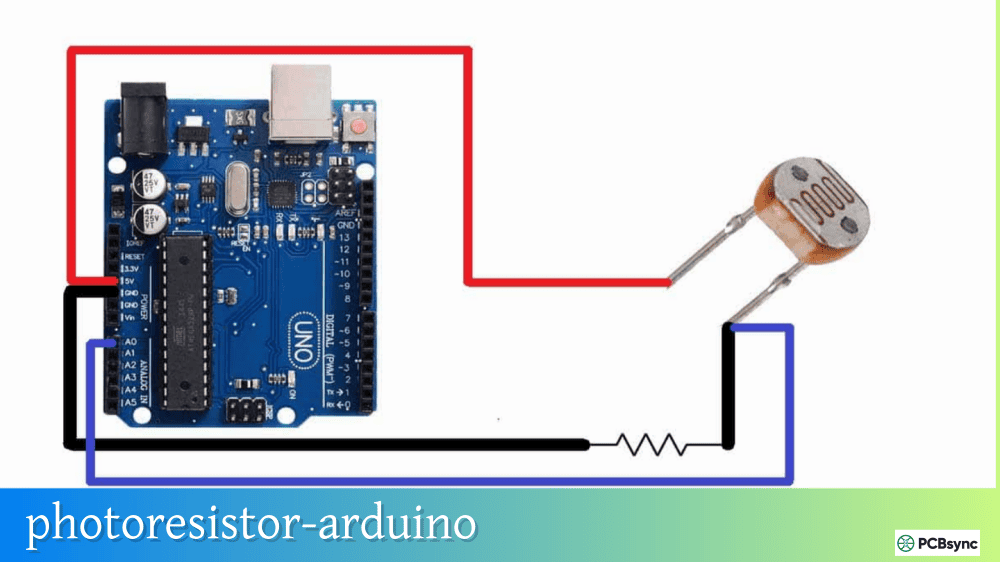
Arduino Wiring Diagram
Pot Pin 1 -> Arduino GND
Pot Pin 2 -> Arduino A0 (Analog Input)
Pot Pin 3 -> Arduino 5V (or 3.3V depending on board)
The Code: Reading the Analog Signal
When you use analogRead(), the Arduino converts the voltage (0V to 5V) into a range of integers from 0 to 1023.
C++
// Basic 10K Potentiometer Read Scriptconst int potPin = A0; // Wiper connected to A0int potValue = 0; // Variable to store the raw value
void setup() {
Serial.begin(9600);
}
void loop() {
potValue = analogRead(potPin); // Read the 10k ohm potentiometer
float voltage = potValue * (5.0 / 1023.0); // Convert to actual voltage
You can use the output of a 10k potentiometer to control the brightness of an LED or the speed of a DC motor. Since analogRead() returns 0–1023 and analogWrite() requires 0–255, we use the map() function.
int ledBrightness = map(potValue, 0, 1023, 0, 255);
2. Servo Motor Positioning
Servos require a specific pulse width. By mapping the 10k pot’s value to a range of 0–180 degrees, you create a manual physical controller for robotic arms.
3. Variable Frequency Oscillators
In analog synth design, the 10k pot is used in conjunction with an op-amp to change the RC (Resistor-Capacitor) time constant, effectively changing the pitch or frequency of a wave.
Selection Guide: What to Look for in a 10K Pot
Not all 10k ohm potentiometers are created equal. When speccing a part for a PCB or a rugged project, consider these factors:
Rotational Life: Cheap pots are rated for 10,000 cycles. Industrial versions (like those from Bourns or BI Technologies) can last 1,000,000+ cycles.
Tolerance: A standard 10k pot usually has a $\pm20\%$ tolerance. If you need precision, look for $\pm5\%$ or use a multi-turn “helipot.”
Power Rating: Most 10k pots are 0.125W to 0.5W. They are signal-level devices; never try to run a motor directly through the wiper.
Shaft Type: D-shaft, knurled, or plain? Ensure your knob choice matches the shaft style to avoid slipping.
Troubleshooting Common Issues
Jittery or Jumping Values
This is usually caused by a “dirty” resistive track or a loose connection.
Fix: Use a shot of electrical contact cleaner (like DeoxIT) inside the pot housing.
Software Fix: Implement a simple “moving average” filter in your Arduino code to smooth out the spikes.
The “Dead Zone”
If the value stays at 0 or 1023 for the first few degrees of rotation, you have a low-quality pot with poor end-stop linearity.
Fix: Calibrate your software to ignore the first and last 5% of the range.
Overheating
If the potentiometer gets hot to the touch, you have likely miswired it.
Check: Ensure you haven’t connected the wiper (Pin 2) directly to 5V and GND simultaneously, creating a short circuit when turned to one extreme.
Useful Resources for Engineers
Bourns Potentiometer Handbook: The definitive guide to variable resistor physics.
Arduino Language Reference: Essential for analogRead() and map() documentation.
SnapEDA / DigiKey: For downloading 10k potentiometer footprints and 3D STEP models for PCB design.
Datasheet Database: Look up the WH148 or RK097 series for mechanical dimensions.
FAQs
1. Can I use a 50k or 100k pot instead of a 10k?
Yes, you can. However, as the resistance increases, the signal becomes more susceptible to noise. A 10k ohm potentiometer is the best balance for Arduino-style ADCs.
2. What is a “Multi-turn” potentiometer?
While a standard pot rotates about 270 degrees, a multi-turn pot (usually 10 or 25 turns) allows for ultra-fine adjustments. These are common in precision power supplies.
3. How do I know if my pot is Linear or Logarithmic?
Look at the code on the back. “B10K” usually denotes a Linear 10k pot, while “A10K” often denotes a Logarithmic (Audio) taper.
4. Can a 10k potentiometer handle AC voltage?
Yes, but stay within the voltage and power ratings. If you are controlling AC mains power, you should be using the pot to control a Triac or Dimmer circuit, not passing the AC through the pot itself.
5. Why is my Arduino reading 1023 regardless of knob position?
This happens if the Ground (Pin 1) is disconnected. The input pin “floats” up to the VCC voltage, resulting in a maximum reading. Check your ground rail.
Summary
The 10k potentiometer is the bridge between the physical world and your digital code. By understanding the pinout and applying basic engineering principles—like bypass capacitors for noise and proper taper selection—you can move beyond simple “knob turning” to creating precise, reliable user interfaces.
When in doubt, always measure the resistance between Pin 1 and Pin 3 with a multimeter first; if it isn’t close to 10,000 ohms, you might have a damaged component or a different value entirely.
Inquire: Call 0086-755-23203480, or reach out via the form below/your sales contact to discuss our design, manufacturing, and assembly capabilities.
Quote: Email your PCB files to Sales@pcbsync.com (Preferred for large files) or submit online. We will contact you promptly. Please ensure your email is correct.
Notes: For PCB fabrication, we require PCB design file in Gerber RS-274X format (most preferred), *.PCB/DDB (Protel, inform your program version) format or *.BRD (Eagle) format. For PCB assembly, we require PCB design file in above mentioned format, drilling file and BOM. Click to download BOM template To avoid file missing, please include all files into one folder and compress it into .zip or .rar format.