Inquire: Call 0086-755-23203480, or reach out via the form below/your sales contact to discuss our design, manufacturing, and assembly capabilities.
Quote: Email your PCB files to Sales@pcbsync.com (Preferred for large files) or submit online. We will contact you promptly. Please ensure your email is correct.
Notes: For PCB fabrication, we require PCB design file in Gerber RS-274X format (most preferred), *.PCB/DDB (Protel, inform your program version) format or *.BRD (Eagle) format. For PCB assembly, we require PCB design file in above mentioned format, drilling file and BOM. Click to download BOM template To avoid file missing, please include all files into one folder and compress it into .zip or .rar format.
If you’ve landed here, chances are you’re either designing something incredibly complex or you’re curious about how far PCB technology has actually come. Either way, you’re in the right place. As someone who’s spent years in PCB design and manufacturing, I can tell you that 100 layer PCB technology represents the absolute pinnacle of what’s possible in printed circuit board fabrication today.
This guide breaks down everything you need to know about 100 layer PCBs, from the manufacturing process and material selection to real-world applications and cost considerations. No fluff, just the practical stuff that actually matters when you’re evaluating whether this technology fits your project.
A 100 layer PCB is an ultra-high-density multilayer printed circuit board containing 100 individual conductive copper layers separated by dielectric materials. Each layer is precisely aligned and laminated together to create a single, unified board structure.
To put this in perspective, most consumer electronics use 4 to 8 layer boards. High-performance computing might push to 20 or 30 layers. Military and aerospace applications commonly use 40 to 60 layers. A 100 layer PCB sits at the extreme end of this spectrum, reserved for applications where component density, signal integrity, and performance requirements push beyond what conventional multilayer boards can deliver.
The jump from a standard multilayer PCB to a 100 layer board isn’t just about adding more copper. It requires fundamentally different design approaches, specialized materials, and manufacturing capabilities that only a handful of fabricators worldwide can actually deliver.
Why Would Anyone Need a 100 Layer PCB?
This is the question I get asked most often. The honest answer is that most projects don’t need 100 layers. But for certain applications, nothing else will work.
High-Density Interconnect Requirements
When you’re routing thousands of signals between multiple high-pin-count BGAs, ASICs, and FPGAs on a single board, layer count becomes a mathematical necessity. Each signal needs its own routing channel, and reference planes are essential for impedance control. At a certain point, you simply run out of routing real estate on lower layer counts.
Signal Integrity in High-Speed Designs
100 layer PCBs allow engineers to dedicate multiple ground and power planes throughout the stack-up. This provides better EMI shielding, lower impedance power delivery, and controlled impedance for differential pairs running at multi-gigabit speeds.
Size and Weight Constraints
Paradoxically, going to more layers often means a smaller overall board footprint. In aerospace and defense applications, where every gram and cubic centimeter counts, a 100 layer PCB might actually be the most compact solution for complex system requirements.
100 Layer PCB Stack-Up Design
Stack-up design is where 100 layer PCB projects succeed or fail. Get this wrong, and you’ll have signal integrity nightmares, warping issues, or a board that simply can’t be manufactured.
Core vs. Prepreg Configuration
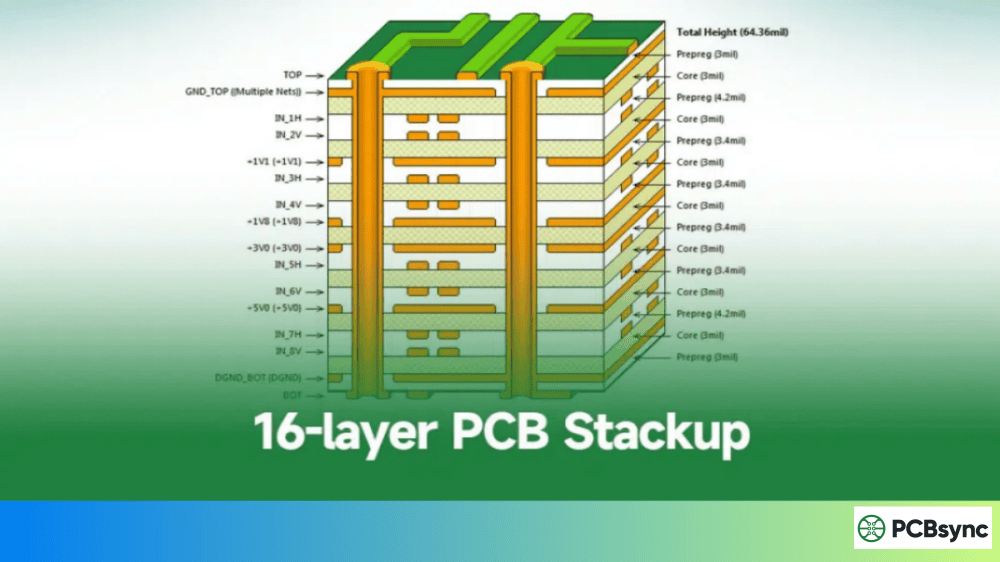
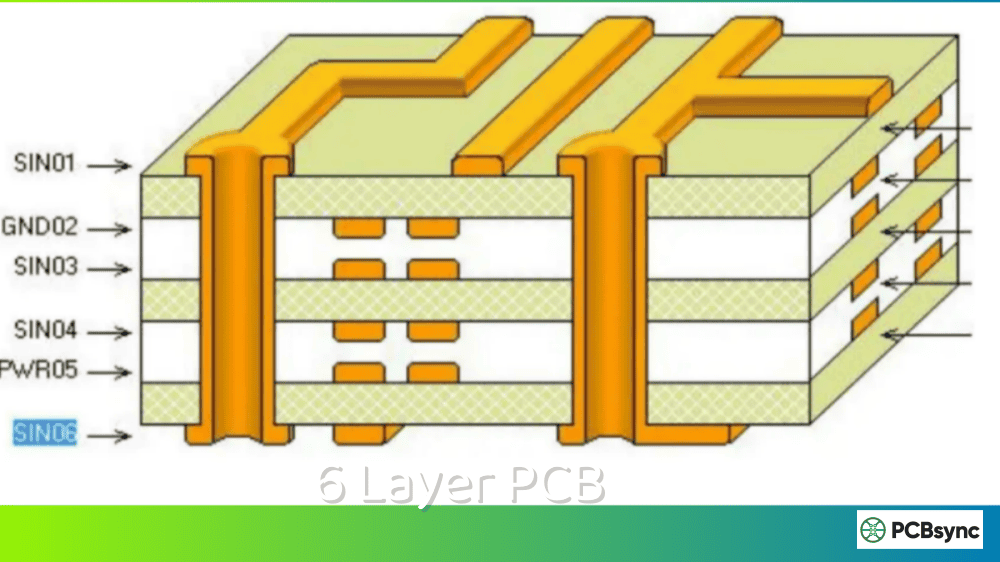
A typical 100 layer PCB uses a combination of cores (copper-clad laminate sheets) and prepreg (pre-impregnated bonding material) in a carefully balanced arrangement. The goal is symmetry around the board’s center to minimize warpage during thermal cycling.
Layer Function Allocation
Here’s how layer allocation typically breaks down in a 100 layer design:
Layer Type
Typical Quantity
Purpose
Signal Layers
50-60
High-speed routing, differential pairs
Ground Planes
20-25
Reference planes, EMI shielding
Power Planes
15-20
Multiple voltage rails distribution
Mixed Signal/Power
5-10
Hybrid layers for specific routing needs
Symmetry Requirements
Maintaining symmetry in a 100 layer stack-up is non-negotiable. The stack must be balanced around the center to prevent bow and twist. This means if you have a 2oz copper layer on layer 10, you need a matching 2oz layer at the corresponding position from the bottom.
Material Selection for 100 Layer PCBs
Standard FR-4 won’t cut it for most 100 layer applications. Here’s what actually works:
With 100 layers, every material property gets amplified. A slightly higher dissipation factor (Df) that’s acceptable in an 8-layer board becomes a major signal loss problem when your traces run through dozens of via transitions. The cumulative effect of insertion loss across a 100 layer board can render high-speed signals unusable if material selection isn’t optimized.
Glass weave style also matters significantly. Using spread glass or flat glass weaves reduces the fiber weave effect that causes skew in differential pairs, which is critical when you’re routing hundreds of high-speed differential pairs.
Manufacturing Process for 100 Layer PCBs
Manufacturing a 100 layer PCB is an exercise in precision engineering. The process pushes fabrication equipment and techniques to their absolute limits.
Sequential Lamination
Unlike standard multilayer boards that can be laminated in a single press cycle, 100 layer PCBs require sequential lamination. This means the board is built up in stages, typically 10-15 layers at a time, with each sub-stack being drilled and plated before the next lamination cycle.
A typical sequence might look like this:
Build inner core sub-stacks (layers 40-60)
Laminate and drill sub-stack
Plate through-holes in sub-stack
Add next layer groups (layers 25-39, 61-75)
Laminate, drill, and plate
Continue until all layers complete
Final outer layer processing
Registration and Alignment
Maintaining layer-to-layer registration across 100 layers is the biggest manufacturing challenge. Each lamination cycle introduces potential for movement. Fabricators use X-ray drilling systems and optical alignment targets on every layer to maintain registration within ±2 mils, which is essential for reliable via connections.
The registration challenge compounds with each sequential lamination step. Consider that a buried via connecting layers 45 to 55 must align perfectly with capture pads on both layers, despite those layers being laminated in different press cycles. Any cumulative drift exceeds the annular ring tolerance, and you’ve got opens or reliability failures waiting to happen.
Advanced fabricators address this through a combination of techniques: pinless lamination systems that reduce mechanical stress, controlled environment processing to minimize humidity-related dimensional changes, and real-time X-ray verification at critical process steps. Some facilities use automated optical inspection on every inner layer before lamination, catching registration issues before they become buried defects.
Drilling Challenges
Drilling through 100 layers presents unique challenges that don’t exist in standard multilayer boards. The total board thickness of 4-6mm means aspect ratios push against the limits of mechanical drilling capability. For through-holes, most fabricators limit aspect ratios to 10:1 or 12:1 maximum, which constrains minimum hole sizes.
Drill bit wear accelerates dramatically when drilling through this much material. Fabricators typically use fresh drill bits more frequently and may employ backup drilling or step drilling techniques to maintain hole quality through the full stack. Hole wall roughness becomes critical at these thicknesses because plating must cover the entire barrel uniformly to ensure electrical reliability.
For blind and buried vias, laser drilling is standard practice. CO2 lasers handle dielectric removal while UV lasers can drill through copper. The sequential build process means these laser-drilled features must survive subsequent lamination cycles without damage, adding another constraint to the manufacturing process.
Complex via structures are essential in 100 layer designs:
Via Type
Description
Typical Use
Through-hole
Spans all 100 layers
Power distribution, low-speed signals
Blind Via
Connects outer layer to inner layer
BGA breakout, surface component routing
Buried Via
Connects internal layers only
Inner layer signal routing
Stacked Microvia
Multiple microvias stacked vertically
HDI fanout, space-constrained areas
Staggered Microvia
Offset microvias across layers
Reliability-critical applications
Back-drilling is almost always required to remove unused via stubs that would otherwise cause signal reflections at high frequencies.
Design Rules and Constraints
Working with 100 layer PCBs requires tighter design rules than standard boards. Here’s what you’re typically dealing with:
Trace and Space Requirements
Parameter
Typical Value
Notes
Minimum Trace Width
3 mil (75μm)
Inner layers
Minimum Spacing
3 mil (75μm)
Signal-to-signal
Microvia Diameter
4 mil (100μm)
Laser drilled
Microvia Pad
10 mil (250μm)
Capture pad
Aspect Ratio
12:1 maximum
Through-hole vias
Board Thickness
180-250 mil
Varies by design
Impedance Control Challenges
Controlling impedance across 100 layers requires careful attention to:
Dielectric thickness consistency between layers
Copper thickness variation compensation
Glass weave style selection for consistent Dk
Etch factor compensation for different copper weights
Most 100 layer designs require impedance tolerance of ±7% or better, which demands tight process control throughout manufacturing.
Applications of 100 Layer PCB Technology
100 layer PCBs show up in some of the most demanding electronic systems ever built. Understanding where this technology actually gets deployed helps frame realistic expectations about when it makes sense for your project.
Supercomputing and Data Centers
Modern supercomputers and hyperscale data center switches use 100 layer PCBs to interconnect hundreds of high-speed SerDes channels. A single backplane might carry over 1,000 differential pairs running at 56Gbps or higher.
The networking switch market drives a lot of 100 layer PCB demand. When you’re building a switch ASIC with 512 SerDes lanes running at 112Gbps PAM4, and each lane needs controlled impedance differential routing with proper reference planes, the layer count math quickly pushes past 80-90 layers. Add in power delivery for a 500W+ device and you’re firmly in 100 layer territory.
Aerospace and Defense Systems
Advanced radar systems, electronic warfare equipment, and satellite payloads often require 100 layer PCBs. The combination of extreme component density, environmental requirements, and reliability demands makes high layer counts necessary.
Phased array radar systems are particularly demanding. A single antenna element module might require dozens of RF channels, digital control paths, and power distribution, all in a constrained footprint that must survive extreme temperature cycling, vibration, and radiation exposure. These requirements frequently push designs beyond what 60-70 layer boards can accommodate.
Medical Imaging Equipment
High-end CT scanners and MRI systems use 100 layer PCBs in their data acquisition and processing systems. These applications require massive parallel data paths with precise timing relationships.
A modern CT scanner data acquisition system might process signals from thousands of detector elements simultaneously. Each channel requires analog front-end circuitry, ADC interfaces, and high-speed digital links back to the image reconstruction processor. The combination of analog isolation requirements, digital routing density, and power distribution creates layer count pressure that often lands in the 90-100 layer range.
Telecommunications Infrastructure
5G base station equipment and optical networking gear increasingly push toward 100 layer designs as data rates climb and antenna element counts increase in massive MIMO systems.
Semiconductor Test Equipment
Automated test equipment (ATE) for validating advanced semiconductor devices requires 100 layer PCBs to provide thousands of test channels with controlled impedance and precise timing.
Cost Factors for 100 Layer PCBs
Let’s be direct about this: 100 layer PCBs are expensive. Understanding what drives cost helps you make informed decisions.
Primary Cost Drivers
Factor
Impact on Cost
Why It Matters
Layer Count
Very High
Each layer adds material and process steps
Sequential Lamination
High
Multiple press cycles, longer lead time
Material Selection
High
High-performance laminates cost 5-10x more
Via Complexity
Medium-High
Back-drilling, microvias add process steps
Tolerance Requirements
Medium
Tighter specs mean lower yields
Board Size
Medium
Larger boards = more material, lower yield
Quantity
Medium
Higher volume reduces per-unit cost
Realistic Cost Expectations
For a typical 100 layer PCB prototype (18″ x 24″ panel size, high-performance material):
Engineering and tooling: $15,000 – $50,000
Per-board cost (prototype qty): $3,000 – $10,000
Lead time: 8-16 weeks
Production quantities bring per-unit costs down significantly, but 100 layer boards will always carry a substantial premium over standard multilayer designs.
Selecting a 100 Layer PCB Manufacturer
Not every PCB fabricator can produce 100 layer boards. When evaluating potential suppliers for PCB manufacturing at this level, consider:
Technical Capabilities to Verify
Maximum layer count (should be 100+ with proven track record)
Sequential lamination experience
Registration capability (should be ±2 mils or better)
Available high-performance materials
Via technologies supported
Impedance control tolerance
Quality Certifications That Matter
AS9100 for aerospace applications
ISO 13485 for medical devices
ITAR registration for defense work
IPC-6012 Class 3 or Class 3/A capability
Nadcap accreditation for aerospace
Questions to Ask Potential Suppliers
How many 100 layer boards have you produced in the last year?
What’s your first-pass yield on 100 layer designs?
Can you provide references from similar projects?
What DFM feedback do you provide before production?
How do you handle layer-to-layer registration verification?
Design Tips From the Trenches
After working on several 100 layer projects, here are lessons learned the hard way:
Start with Stackup Planning
Don’t even think about placement until your stack-up is finalized. Work with your fabricator early to validate the stack-up before committing to a design direction.
Plan Via Structures Carefully
Map out your via strategy before routing. Know which layers each via type will span, and design your fanout patterns around those constraints.
Budget Extra Time for Signal Integrity Analysis
100 layer designs require more extensive SI/PI simulation than typical boards. Plan for multiple analysis iterations and allow time to implement findings.
Communicate Early with Your Fabricator
The best 100 layer projects involve the fabricator as a design partner, not just a vendor. Their DFM input can save you from costly respins.
Don’t Forget Thermal Management
100 layers of copper create a significant thermal mass. Model your thermal behavior and plan for heat spreading paths through the stack-up.
Useful Resources for 100 Layer PCB Design
Industry Standards and Specifications
IPC-2226: Sectional Design Standard for HDI Printed Boards
IPC-6012: Qualification and Performance Specification for Rigid PCBs
IPC-2152: Standard for Determining Current Carrying Capacity in Printed Board Design
IPC-2141: Design Guide for High-Speed Controlled Impedance Circuit Boards
As semiconductor packaging moves toward chiplet architectures, the interposers and substrates connecting these chiplets are approaching PCB-like layer counts with even finer features.
Optical Integration
Embedded optical waveguides may eventually supplement copper traces in ultra-high layer count boards, potentially reducing layer requirements while increasing bandwidth density.
Advanced Materials
New low-loss materials continue to push the boundaries of what’s achievable in terms of signal integrity at extreme frequencies, making 100+ layer designs more practical for emerging applications.
Frequently Asked Questions About 100 Layer PCBs
What is the maximum number of layers possible in a PCB?
Current manufacturing technology has produced PCBs with over 100 layers, with some specialized fabricators claiming capability up to 120-130 layers. The practical limit depends on total board thickness constraints, via aspect ratios, and registration accuracy. Most applications that require more than 100 layers are better served by splitting the design across multiple interconnected boards.
How thick is a 100 layer PCB?
A typical 100 layer PCB ranges from 180 mils (4.5mm) to 250 mils (6.35mm) in total thickness. The exact thickness depends on the dielectric materials used, copper weights on each layer, and any thickness constraints imposed by the application. Thinner dielectrics can reduce overall thickness but may impact impedance control and crosstalk performance.
How long does it take to manufacture a 100 layer PCB?
Lead times for 100 layer PCB prototypes typically range from 8 to 16 weeks, depending on the fabricator’s workload, material availability, and design complexity. Production quantities may have shorter per-unit cycle times once tooling is complete, but initial prototype builds require extensive engineering review, multiple lamination cycles, and thorough quality verification.
Can any PCB manufacturer produce 100 layer boards?
No. Only a small number of specialized PCB fabricators worldwide have the equipment, expertise, and process control required for 100 layer production. These capabilities include advanced sequential lamination presses, X-ray drilling systems, high-precision registration equipment, and extensive experience with ultra-high layer count designs. Always verify a supplier’s track record with similar layer counts before committing.
When should I consider a 100 layer PCB versus other solutions?
Consider 100 layer PCBs when your design requires routing density that can’t be achieved with lower layer counts, when signal integrity requirements demand extensive reference planes and shielding, or when size constraints prevent spreading functionality across multiple boards. If your layer count estimate exceeds 60-70 layers, engage with a capable fabricator early to explore whether 100 layer technology is the right solution or if alternative architectures might work better.
Inquire: Call 0086-755-23203480, or reach out via the form below/your sales contact to discuss our design, manufacturing, and assembly capabilities.
Quote: Email your PCB files to Sales@pcbsync.com (Preferred for large files) or submit online. We will contact you promptly. Please ensure your email is correct.
Notes: For PCB fabrication, we require PCB design file in Gerber RS-274X format (most preferred), *.PCB/DDB (Protel, inform your program version) format or *.BRD (Eagle) format. For PCB assembly, we require PCB design file in above mentioned format, drilling file and BOM. Click to download BOM template To avoid file missing, please include all files into one folder and compress it into .zip or .rar format.