Inquire: Call 0086-755-23203480, or reach out via the form below/your sales contact to discuss our design, manufacturing, and assembly capabilities.
Quote: Email your PCB files to Sales@pcbsync.com (Preferred for large files) or submit online. We will contact you promptly. Please ensure your email is correct.
Notes: For PCB fabrication, we require PCB design file in Gerber RS-274X format (most preferred), *.PCB/DDB (Protel, inform your program version) format or *.BRD (Eagle) format. For PCB assembly, we require PCB design file in above mentioned format, drilling file and BOM. Click to download BOM template To avoid file missing, please include all files into one folder and compress it into .zip or .rar format.
If you are new to electronics, looking at a Bill of Materials (BOM) and seeing a “0 ohm resistor” can feel like a practical joke. A resistor, by definition, opposes current flow. So, what is the point of a component that offers no resistance? Is it just a wire in a fancy suit?
The short answer is: Yes, it is a wire in a fancy suit. But in the world of Printed Circuit Board (PCB) manufacturing, that “suit” saves millions of dollars, simplifies automated assembly, and rescues designers from routing nightmares.
As a PCB engineer, I can tell you that the 0 ohm resistor is one of the most versatile tools in my library. It isn’t about electrical properties; it’s about mechanical and logistical utility. This guide will break down exactly why we use them, how to select them, and the engineering “hacks” they enable.
Technically, a 0 ohm resistor (often written as 0Ω or “Zero Ohm Link”) is a passive component with approximately zero resistance. I say “approximately” because nothing in the physical world is perfect. Even a pure copper wire has resistance.
In the industry, we generally accept that a 0Ω resistor has a maximum resistance of 10 to 50 milliohms.
Identification and Appearance
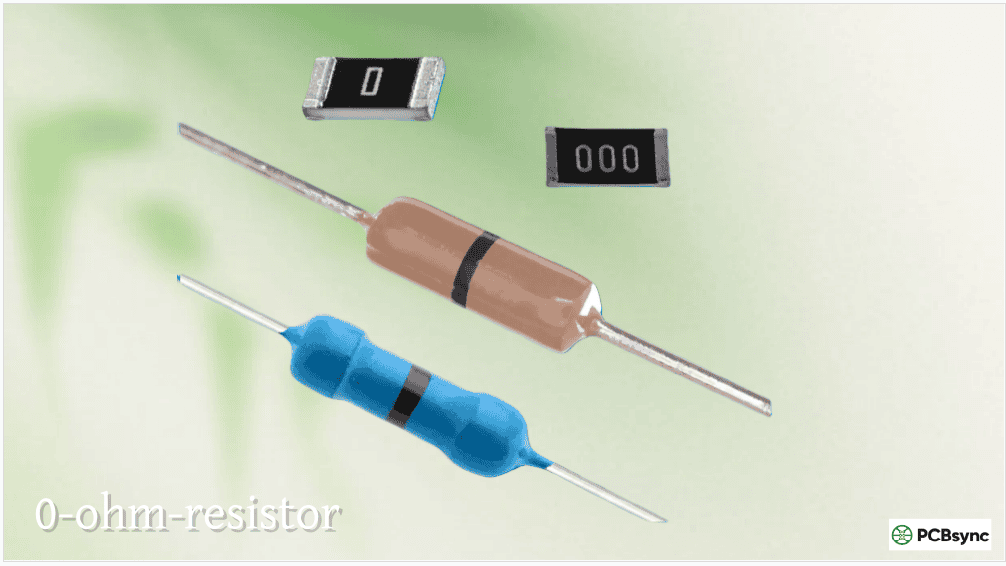
You will encounter these in two main forms:
1. Through-Hole (Axial)
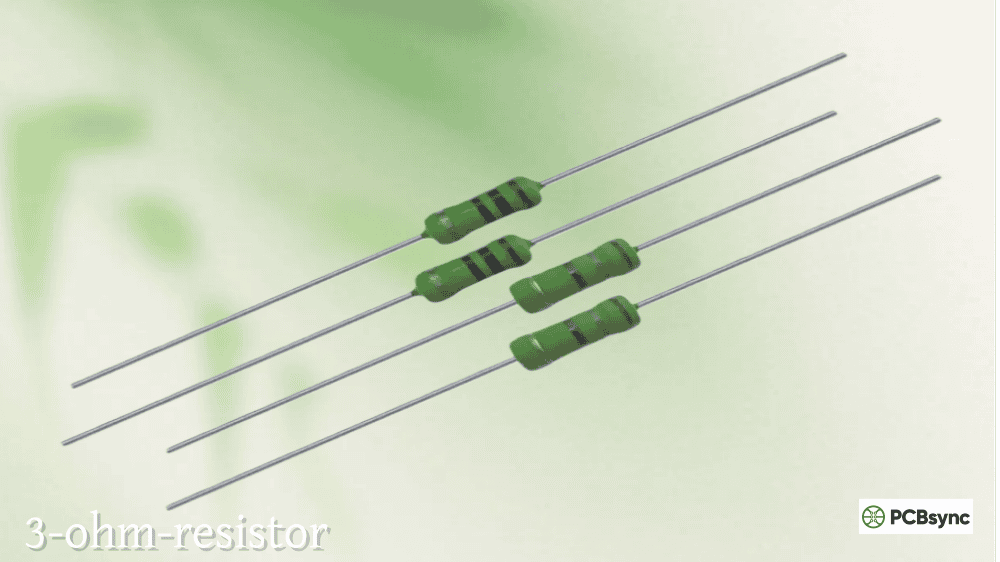
These look exactly like standard beige or blue resistors, but they have a unique color code.
Color Code: A single Black band in the center.
Meaning: Black = 0. No multiplier, no tolerance. Just zero.
2. Surface Mount Device (SMD)
These are the tiny rectangular chips found on modern circuit boards.
Marking: Usually marked with a single “0” or “000”.
No Marking: In very small packages (like 0402 or 0201), there is often no marking at all due to lack of space. You have to rely on the reel label.
Why Use a 0 Ohm Resistor Instead of a Wire?
This is the most common question I hear. Why pay $0.001 for a resistor when a piece of jumper wire is effectively free?
The answer lies in Mass Production.
1. Automated Pick-and-Place
Modern PCBs are assembled by high-speed machines that grab components from tape reels and place them onto the board. These machines are designed to handle standard component packages (like 0603, 0805, or SOIC).
The Problem: A machine cannot easily grab a loose piece of wire, cut it to size, strip the ends, and shape it. That requires a specialized, slow, and expensive machine.
The Solution: A 0 ohm resistor comes in the exact same shape and packaging as a 10kΩ resistor. The machine doesn’t know the difference. It places the 0Ω link just as fast as any other part.
Result: You save massive amounts of time and assembly cost.
2. Single-Layer PCB Routing (The “Bridge”)
This is a classic layout trick. If you are designing a cheap, single-layer PCB (common in household appliances like microwaves or coffee makers), you cannot route traces over each other.
If you get stuck and need to cross a signal line over a power line, you place a 0 ohm resistor. It acts as a bridge, jumping over the trace underneath it.
Top 5 Engineering Applications
Beyond just being a glorified wire, we use the 0 ohm resistor for strategic design reasons.
1. Circuit Configuration (Hardware Selection)
Imagine you are designing a chip that needs to work in both the USA (60Hz) and Europe (50Hz). You don’t want to design two different boards.
Instead, you design one board with a “Select” pin.
Scenario A: Solder a 0Ω resistor at position R1 to pull the pin HIGH (USA Mode).
Scenario B: Solder the 0Ω resistor at position R2 to pull the pin LOW (Europe Mode).
This allows the same blank PCB to be used for multiple products just by changing the BOM.
2. Fuse Replacement (The “Sacrificial” Component)
While not a precision fuse, a 0 ohm resistor can act as a crude over-current protection device. If a serious short circuit occurs, the tiny internal element of the resistor will burn out and open the circuit.
Warning: Do not rely on this for critical safety. The “blow” current is not precise. However, for preventing trace damage during prototyping, it is better than nothing.
3. Debugging and Current Measurement
When I design a new board, I often place a 0 ohm resistor in series with the power supply of a major IC (like a microcontroller).
Why?
Debugging: If the chip locks up, I can desolder the resistor to isolate power to just that chip without cutting traces.
Measurement: I can remove the 0Ω resistor and solder two loops of wire to hook up my multimeter current probes. This lets me measure the power consumption of that specific sub-circuit.
4. Preventing Reverse Engineering
This is a “Black Hat” technique. Sometimes companies cover their tracks by using 0 ohm resistors to mislead copycats.
A competitor might see a resistor in a spot and assume it’s part of a filter, spending hours trying to calculate the RC time constant, only to realize later it’s just a short circuit. It confuses the schematic for anyone trying to clone the board.
5. Ground Point Separation
In mixed-signal designs (Analog vs. Digital), we often keep Analog Ground (AGND) and Digital Ground (DGND) separate to prevent noise. However, they must connect at a single point eventually.
Designers often use a 0 ohm resistor to join them. This gives flexibility:
If the noise is bad, we can swap the 0Ω resistor for a Ferrite Bead or an Inductor later without spinning a new board layout.
A common mistake junior engineers make is assuming a 0 ohm resistor can handle infinite current. It cannot. It has a physical limit based on its package size and thermal dissipation.
If you push 5 Amps through a tiny 0402 resistor, it will heat up and fail.
Typical Current Ratings for SMD 0 Ohm Resistors:
Package Size
Imperial Code
Metric Code
Max Current (Approx)
Max Power Dissipation
0201
0603
0.5A
0.05W
0402
1005
1.0A
0.063W
0603
1608
1.0A – 2.0A
0.1W
0805
2012
2.0A – 3.0A
0.125W
1206
3216
3.0A – 4.0A
0.25W
Note: These values vary by manufacturer (Vishay, Yageo, Panasonic). Always check the datasheet for the specific “Jumper Current Rating.”
0 Ohm Resistor vs. Alternatives
When should you use a zero ohm link versus other “shorting” methods?
Component
Pros
Cons
Best Use
0 Ohm Resistor
Machine assemblable, cheap, compact.
Limited current, adds resistance (mΩ).
Signal jumping, config, debugging.
Wire Jumper
High current, zero cost (material).
Expensive to assemble (manual labor).
Prototyping, High power mains.
Solder Bridge
Free, no parts needed.
Messy, hard to control, looks unprofessional.
Quick hacks, “Cut-trace-and-strap”.
Ferrite Bead
Filters high-frequency noise.
DC resistance is higher than 0Ω.
EMI suppression on power lines.
Practical Resources
For those looking to dive deeper into the datasheets or add these to your CAD library, here are some standard resources:
DigiKey / Mouser: Search for “Zero Ohm Jumper” or “0 Ohm Resistor”. You will find thousands of options.
Saturn PCB Toolkit: A vital free software for calculating via currents and trace widths, which helps you decide if you need a bigger 0 ohm resistor.
Vishay / Yageo Datasheets: Look for the “RC Series” or “CR Series” datasheets to see the exact fusing characteristics of their zero ohm links.
FAQ: Common Questions from the Lab
1. Can I just use a blob of solder instead of a 0 ohm resistor?
If you designed the pads specifically for it (called a “solder jumper” pad), yes. However, trying to bridge a gap meant for a resistor with just solder is bad practice. Solder has surface tension and might pull apart, creating an “open” circuit, or it might drip and cause a short elsewhere.
2. Does a 0 ohm resistor have tolerance?
No, because 5% of 0 is still 0. However, datasheets will often list a “maximum resistance.” For example, a “5%” zero ohm resistor implies a standard commercial grade (max 50mΩ), whereas a high-precision grade might guarantee <10mΩ.
3. Are 0 ohm resistors inductive?
Yes, slightly. Any conductor has inductance. At high frequencies (RF range, GHz), a 0 ohm resistor has impedance. If you are designing RF circuits, you must model the zero ohm link as a small inductor, or use specialized “Low ESL” jumpers.
4. Can I put multiple 0 ohm resistors in parallel for higher current?
Yes. If you need to pass 4 Amps but only have 0805 resistors (rated for 2A), you can place two in parallel. Just ensure your PCB traces are wide enough to handle the current entering and exiting the pair.
5. Why is there a black band on the through-hole version?
It is simply the industry standard for “Zero.” In the standard color code, Black = 0. Since there are no other digits or multipliers needed, a single black band is the most logical way to indicate the value without confusion.
Conclusion
The 0 ohm resistor is the unsung hero of the electronics world. It solves manufacturing problems, enables flexible designs, and helps engineers debug complex systems. It is the perfect example of how engineering isn’t just about the laws of physics—it’s about the laws of economics and logistics.
So the next time you see a “useless” resistor on a board, you’ll know it’s actually working harder than almost any other component to make that board manufacturable.
Inquire: Call 0086-755-23203480, or reach out via the form below/your sales contact to discuss our design, manufacturing, and assembly capabilities.
Quote: Email your PCB files to Sales@pcbsync.com (Preferred for large files) or submit online. We will contact you promptly. Please ensure your email is correct.
Notes: For PCB fabrication, we require PCB design file in Gerber RS-274X format (most preferred), *.PCB/DDB (Protel, inform your program version) format or *.BRD (Eagle) format. For PCB assembly, we require PCB design file in above mentioned format, drilling file and BOM. Click to download BOM template To avoid file missing, please include all files into one folder and compress it into .zip or .rar format.