Inquire: Call 0086-755-23203480, or reach out via the form below/your sales contact to discuss our design, manufacturing, and assembly capabilities.
Quote: Email your PCB files to Sales@pcbsync.com (Preferred for large files) or submit online. We will contact you promptly. Please ensure your email is correct.
Notes: For PCB fabrication, we require PCB design file in Gerber RS-274X format (most preferred), *.PCB/DDB (Protel, inform your program version) format or *.BRD (Eagle) format. For PCB assembly, we require PCB design file in above mentioned format, drilling file and BOM. Click to download BOM template To avoid file missing, please include all files into one folder and compress it into .zip or .rar format.
When engineers need a thin PCB that can actually support multiple routing layers, the 0.3mm PCB thickness often becomes the answer. Having worked on smartphone and tablet designs where board real estate is measured in fractions of millimeters, I’ve found that 0.3mm represents a critical threshold in PCB technology—it’s the thinnest practical option for reliable 4-layer construction. Below this thickness, you’re essentially limited to single or double-sided boards. At 0.3mm and above, multilayer HDI designs become feasible.
This guide covers everything engineers need to know about designing and manufacturing 0.3mm thin PCBs. From stack-up options and material selection to manufacturing constraints and real-world applications, you’ll find practical guidance drawn from production experience with these challenging but increasingly essential circuit boards.
A 0.3mm PCB is a printed circuit board with a total finished thickness of approximately 0.3 millimeters (300 micrometers or about 0.012 inches). This makes it roughly five times thinner than the industry-standard 1.6mm thickness, yet thick enough to support proper multilayer construction with internal power and ground planes.
The PCB industry categorizes board thickness into several tiers, and 0.3mm sits at an important boundary:
Classification
Thickness Range
Maximum Practical Layers
Ultra-Thin PCB
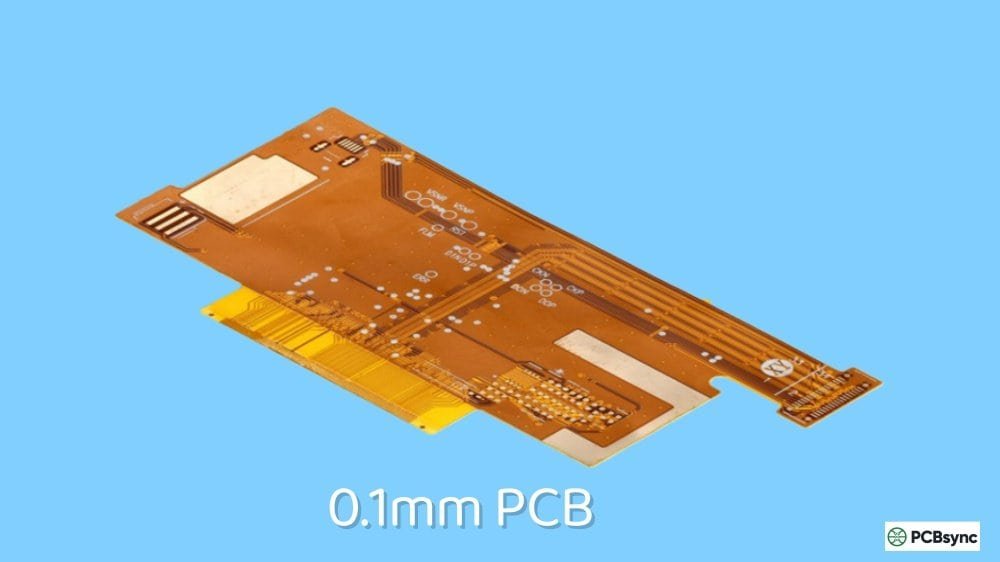
0.1mm – 0.2mm
1-2 layers
Thin PCB
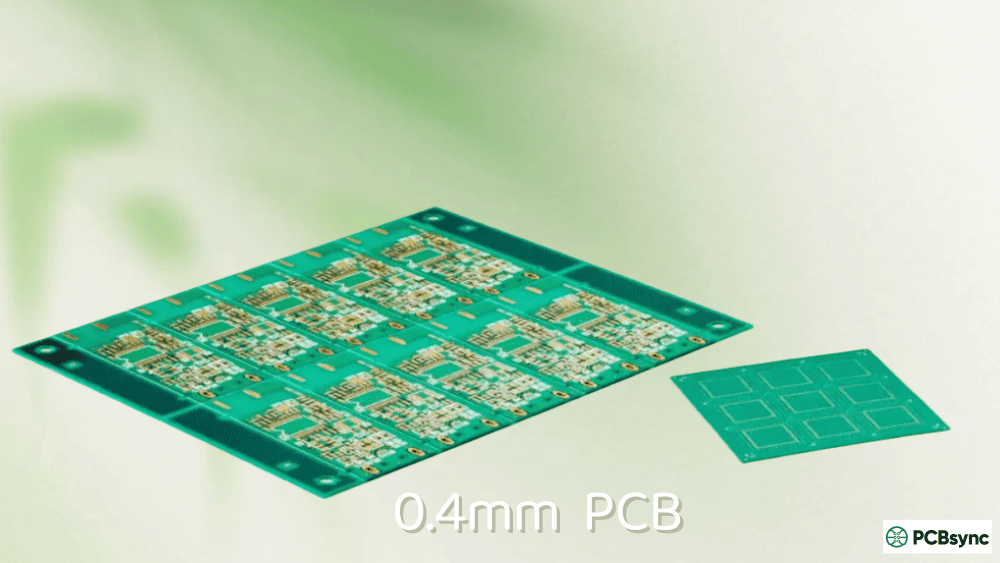
0.3mm – 0.4mm
4 layers
Standard Thin
0.5mm – 0.8mm
4-6 layers
Standard PCB
1.0mm – 1.6mm
6-12+ layers
At 0.3mm, you’re working at what many manufacturers consider the minimum thickness for reliable 4-layer PCBs. This is significant because 4-layer boards provide dedicated ground and power planes—essential for signal integrity in modern high-speed designs.
Why 0.3mm Thickness Matters
The 0.3mm threshold exists for practical PCB manufacturing reasons. To build a multilayer board, you need core material between copper layers plus prepreg to bond everything together. With typical core thicknesses of 0.1mm and prepreg at 0.05-0.08mm, a 4-layer board naturally bottoms out around 0.3mm total thickness.
This makes 0.3mm PCB the go-to choice when designers need:
Multiple routing layers in a thin package
Dedicated power and ground planes for noise reduction
HDI-compatible construction with microvias
Controlled impedance for high-speed signals
0.3mm PCB Materials and Substrate Options
Material selection at 0.3mm thickness affects not just mechanical properties but also what layer counts and constructions become possible. The substrate choice directly impacts your stack-up options.
FR4 for 0.3mm PCB
Standard FR4 remains the workhorse for 0.3mm multilayer boards. At this thickness, FR4 provides adequate rigidity for handling and assembly while enabling thin constructions.
Property
FR4 at 0.3mm Specification
Dielectric Constant (Dk)
4.2 – 4.8 at 1MHz
Glass Transition Temp (Tg)
130°C – 180°C
Thermal Conductivity
0.25 – 0.35 W/m·K
Core Thickness Options
0.1mm, 0.15mm available
CTE (Z-axis)
45-65 ppm/°C
For 0.3mm 4-layer boards, always specify high-Tg FR4 (170°C minimum). The thin construction makes boards more susceptible to warpage during reflow, and high-Tg materials maintain dimensional stability better through thermal cycling.
High-Frequency Materials for 0.3mm PCB
When your design requires controlled impedance above 1GHz or operates in RF/microwave frequency ranges, standard FR4 may not deliver adequate performance. Low-loss materials become necessary:
Material Type
Dk Value
Loss Tangent (Df)
Best For
Standard FR4
4.2-4.8
0.020-0.025
Digital signals <1GHz
Mid-Tg FR4
4.3-4.5
0.018-0.022
Mixed signal, moderate speed
High-Tg FR4
4.2-4.5
0.015-0.020
Lead-free assembly, thermal cycling
Rogers 4350B
3.48
0.0037
RF to 10GHz
Isola I-Speed
3.6
0.009
High-speed digital >5Gbps
The thin dielectric layers in 0.3mm constructions make material Dk variations more impactful on impedance. If your design requires tight impedance control (±5% or better), discuss material options with your fabricator early.
Core and Prepreg Selection for 0.3mm PCB
Building a 0.3mm multilayer board requires careful selection of core and prepreg thicknesses. Common options include:
Component
Available Thicknesses
Notes
Thin Core
0.05mm, 0.075mm, 0.1mm
Used for inner layer pairs
Standard Core
0.1mm, 0.15mm, 0.2mm
Primary structural element
1080 Prepreg
0.065mm (2.6mil)
Thin bonding layer
2116 Prepreg
0.12mm (4.7mil)
Standard bonding
1080×2 Prepreg
0.13mm
Two sheets for thickness
The combination of these materials determines your achievable total thickness and layer-to-layer spacing for impedance calculations.
0.3mm PCB Layer Stack-up Options
The ability to support true multilayer construction is what sets 0.3mm PCB apart from thinner alternatives. Here are practical stack-up configurations:
2-Layer 0.3mm PCB Stack-up
The simplest 0.3mm construction uses a single core:
Layer
Material
Thickness
Top Copper
0.5oz-1oz
17-35μm
Core
FR4
0.25mm
Bottom Copper
0.5oz-1oz
17-35μm
Total
~0.3mm
This configuration works for simpler designs where dedicated planes aren’t required.
4-Layer 0.3mm PCB Stack-up
The more valuable configuration—a true 4-layer board at 0.3mm:
Layer
Function
Material
Thickness
L1 (Top)
Signal
Copper
18μm (0.5oz)
Prepreg
Dielectric
1080
0.065mm
L2
Ground
Copper
18μm
Core
Dielectric
FR4
0.1mm
L3
Power
Copper
18μm
Prepreg
Dielectric
1080
0.065mm
L4 (Bottom)
Signal
Copper
18μm
Total
~0.3mm
This stack-up provides signal-ground-power-signal layer arrangement, offering good EMI performance and return path management for high-speed signals.
HDI 0.3mm PCB Stack-up
For high-density interconnect designs, 0.3mm boards can incorporate blind and buried vias:
Structure
Description
Capability
1+2+1
1 buildup layer each side, 2-layer core
Blind vias L1-L2, L3-L4
Sequential Lamination
Multiple press cycles
Buried vias possible
Microvia Size
Laser-drilled
0.075-0.15mm diameter
HDI construction at 0.3mm requires experienced fabricators with laser drilling capability and precise registration control.
Manufacturing Process for 0.3mm PCB
Manufacturing 0.3mm multilayer boards combines the challenges of thin-board handling with the complexity of multilayer lamination. Understanding these processes helps you design for manufacturability.
Lamination Process
Multilayer 0.3mm PCBs require careful lamination to achieve proper bonding without excessive resin flow:
Process Parameter
0.3mm 4-Layer Specification
Lamination Pressure
250-350 PSI
Temperature Ramp
2-3°C/minute
Cure Temperature
175-185°C
Cure Time
60-90 minutes
Cooling Rate
Controlled, 2-3°C/minute
The thin construction means pressure must be precisely controlled—too much pressure squeezes out resin and causes thickness variation; too little results in poor layer bonding.
Drilling Capabilities for 0.3mm PCB
At 0.3mm thickness, both mechanical and laser drilling are viable:
Drilling Method
Minimum Diameter
Best For
Mechanical Drill
0.15mm (6mil)
Through-holes, larger vias
CO2 Laser
0.1mm (4mil)
Blind vias to copper
UV Laser
0.05mm (2mil)
Microvias, fine features
Aspect ratio (depth to diameter) becomes less constrained at 0.3mm compared to thicker boards. A 0.3mm board can reliably support 0.15mm through-holes with an aspect ratio of 2:1.
Surface Finish Options for 0.3mm PCB
Unlike thinner boards where surface finish options become limited, 0.3mm thickness supports most standard finishes:
Surface Finish
Compatibility
Typical Application
ENIG
Excellent
Fine-pitch, wire bonding
ENEPIG
Excellent
Mixed assembly (gold wire + solder)
OSP
Excellent
Cost-sensitive, short shelf life
Immersion Silver
Good
Flat surface, good solderability
Immersion Tin
Good
Press-fit connectors
HASL (Lead-Free)
Acceptable
Cost-sensitive, larger pitches
HASL becomes viable at 0.3mm thickness because the board has enough rigidity to survive the thermal shock of hot air leveling without excessive warpage. However, for fine-pitch components (0.5mm pitch or less), ENIG remains the preferred choice.
Registration and Tolerance Control
Multilayer registration becomes critical at 0.3mm thickness:
Parameter
Typical Tolerance
Layer-to-Layer Registration
±0.075mm (3mil)
Drill-to-Copper Registration
±0.05mm (2mil)
Overall Thickness
±10% (±0.03mm)
Dielectric Thickness
±0.02mm
These tolerances affect via capture pad sizing and impedance calculations. Always include adequate annular rings (0.1mm minimum) to accommodate registration variation.
Designing for 0.3mm thickness requires attention to both electrical and mechanical constraints. These guidelines reflect what’s achievable with quality fabricators.
Trace and Space Requirements
Design Feature
Minimum Value
Recommended Value
Trace Width
0.075mm (3mil)
0.1mm (4mil)
Trace Spacing
0.075mm (3mil)
0.1mm (4mil)
Annular Ring
0.075mm (3mil)
0.1mm (4mil)
Via-to-Via Spacing
0.2mm
0.25mm
Via-to-Trace Spacing
0.15mm
0.2mm
For HDI designs with microvias, tighter geometries become possible—down to 0.05mm (2mil) trace and space with laser-drilled 0.075mm vias.
Copper Weight Selection for 0.3mm PCB
The thin stack-up limits copper weight options to maintain flatness:
Copper Weight
Thickness
Recommendation for 0.3mm
0.5oz (17μm)
Excellent
Best for signal layers
1oz (35μm)
Good
Acceptable for all layers
1.5oz (52μm)
Marginal
Outer layers only, with care
2oz (70μm)
Not recommended
Causes warpage
Most 0.3mm designs use 0.5oz copper throughout or 0.5oz inner layers with 1oz outer layers. This combination provides adequate current capacity while maintaining board flatness.
Impedance Control on 0.3mm PCB
The thin dielectric layers in 0.3mm stack-ups significantly affect impedance. Example calculations for 0.3mm 4-layer board with 0.065mm prepreg:
Target Impedance
Trace Width
Reference Layer
50Ω Single-ended
0.09mm
Adjacent GND
75Ω Single-ended
0.045mm
Adjacent GND
90Ω Differential
0.075mm trace, 0.1mm gap
Adjacent GND
100Ω Differential
0.075mm trace, 0.15mm gap
Adjacent GND
The narrow dielectric spacing means trace widths run narrower than on thicker boards. This increases routing density but also increases sensitivity to manufacturing variations.
Via Design for 0.3mm PCB
Via Type
Diameter
Application
Through-Hole Via
0.2-0.3mm
Standard interconnect
Blind Via (Laser)
0.1-0.15mm
L1-L2 or L3-L4 connections
Buried Via
0.15-0.2mm
L2-L3 connections (if needed)
Microvia
0.075-0.1mm
HDI, BGA escape routing
For 0.3mm boards, via-in-pad designs with filled and capped vias work well and maximize routing density under fine-pitch components.
0.3mm PCB Applications
The 0.3mm thickness has become essential in applications where multilayer capability must combine with minimal board thickness.
Smartphones and Tablets
Modern smartphones rely heavily on 0.3mm and similar thin multilayer boards:
Application Area
Why 0.3mm Works
Main Logic Board
4-layer capability, fits thin enclosure
RF Front-End Module
Controlled impedance, compact size
Display Driver Board
Space behind display panel
Camera Module
Multiple signals, minimal height
The smartphone industry drives much of the innovation in thin multilayer PCB technology. A typical flagship phone may contain several 0.3mm-class boards performing different functions.
Wearable Electronics
Smartwatches, fitness trackers, and medical wearables benefit from 0.3mm PCBs:
Wearable Type
Board Requirements
Why 0.3mm Fits
Smartwatch
Complex functionality, thin profile
4-layer supports processor + wireless
Fitness Band
Sensor integration, battery management
Multilayer for mixed signals
Hearing Aid
Minimal size, audio processing
Compact multilayer construction
Medical Patch
Skin contact, low profile
Thin enough for comfort
The 4-layer capability allows proper power distribution and ground planes essential for low-noise analog sensor circuits commonly found in wearables.
High-Density Interconnect (HDI) Designs
0.3mm serves as a foundation thickness for HDI constructions:
HDI Type
Stack-up
Total Thickness
1+2+1
Single buildup each side
0.3-0.4mm
2+2+2
Double buildup each side
0.5-0.6mm
Any-Layer
Multiple sequential laminations
Variable
When designs require fine-pitch BGAs (0.4mm pitch or less), HDI with 0.3mm core sections provides the escape routing density needed.
Automotive Electronics
Modern vehicles contain numerous thin multilayer boards:
Automotive Application
Why Thin Multilayer
ADAS Camera Modules
Compact packaging behind windshield
Key Fob Electronics
Pocket-friendly thickness
Sensor Modules
Integration into tight spaces
Display Interfaces
Behind dashboard panels
Automotive applications often require high-Tg materials and extended temperature range qualification for 0.3mm boards.
0.3mm PCB vs Other Thicknesses
Understanding where 0.3mm fits in the thickness spectrum helps with specification decisions:
Thickness
Max Layers
Best Applications
Relative Cost
0.2mm
2L
SIM cards, simple sensors
Higher
0.3mm
4L
Smartphones, wearables, HDI
Moderate
0.4mm
4-6L
Tablets, automotive
Standard
0.6mm
6-8L
Laptops, industrial
Standard
0.8mm
8-10L
Servers, networking
Standard
The 0.3mm sweet spot provides the thinnest viable option when you genuinely need more than two copper layers.
Challenges and Solutions for 0.3mm PCB
Working with 0.3mm multilayer boards introduces specific challenges that require attention during design and manufacturing.
Warpage Control
Challenge
Cause
Solution
Bow during lamination
Uneven copper distribution
Balance copper percentage per layer
Twist after reflow
Asymmetric stack-up
Use symmetric construction
Local warpage
Heavy component areas
Add copper balancing patterns
Copper balancing is essential—aim for within 10% copper coverage difference between corresponding layers (L1 vs L4, L2 vs L3).
Handling and Assembly
Challenge
Solution
Panel flex during printing
Vacuum hold-down fixtures
Board movement during placement
Dedicated thin-board pallets
Warpage during reflow
Reduced ramp rate, board support
Fixture damage during test
Soft-touch probes, vacuum fixtures
Many contract manufacturers require advance notice and may charge premiums (10-20%) for 0.3mm multilayer assembly due to additional handling requirements.
Signal Integrity Considerations
Challenge
Impact
Mitigation
Tight layer spacing
Increased crosstalk
Wider trace spacing, ground shielding
Thin dielectrics
Impedance sensitivity
Tighter tolerance materials
Via stubs
Reflections at high frequencies
Back-drilling or blind vias
For signals above 5Gbps, the thin dielectric layers actually help by reducing via stub length, but careful attention to return paths becomes essential.
How to Order 0.3mm PCB: Specification Checklist
When requesting quotes for 0.3mm multilayer boards, include these specifications:
Parameter
What to Specify
Total Thickness
0.3mm ±10%
Layer Count
2L, 4L (specify clearly)
Stack-up
Provide detailed stack-up or request manufacturer’s standard
Material
FR4, High-Tg FR4, specify Tg if required
Copper Weight
Per layer (e.g., 0.5/0.5/0.5/0.5oz)
Via Types
Through-hole, blind, buried, microvia
Minimum Drill
0.15mm PTH, 0.1mm laser (if applicable)
Min Trace/Space
0.1mm/0.1mm or tighter for HDI
Surface Finish
ENIG, OSP, etc.
Impedance Control
Yes/No, target values with tolerance
Useful Resources for 0.3mm PCB Design
These references provide additional technical depth for thin multilayer PCB design:
IPC Standards:
IPC-2221B: Generic Standard on Printed Board Design
IPC-2226: Sectional Design Standard for HDI
IPC-4101: Specification for Base Materials
IPC-6012: Qualification and Performance for Rigid Printed Boards
A 0.3mm PCB can be built as a simple 2-layer board or as a 4-layer multilayer board. The 4-layer configuration is the more valuable option, as it provides dedicated ground and power planes that aren’t possible at thinner constructions like 0.2mm. For most applications requiring 0.3mm thickness, the 4-layer capability is the primary reason for choosing this specification.
Can I get a 6-layer PCB at 0.3mm thickness?
Achieving a 6-layer board at 0.3mm total thickness is extremely challenging and generally not practical with standard materials. The minimum practical thickness for a 6-layer board is typically 0.5mm-0.6mm. If your design requires six layers, you’ll need to either accept a thicker board or consider HDI techniques with 4 layers plus sequential buildup.
How does 0.3mm PCB cost compare to standard 1.6mm?
Expect 0.3mm 4-layer boards to cost 30-50% more than equivalent 1.6mm 4-layer designs. The premium covers thin material handling, tighter process controls, and specialized lamination cycles. Additionally, yields may be lower on 0.3mm boards, which factors into pricing. For prototypes, the cost premium can be even higher due to setup requirements.
What surface finishes are available for 0.3mm PCB?
At 0.3mm thickness, nearly all standard surface finishes are available including ENIG, ENEPIG, OSP, immersion silver, immersion tin, and even lead-free HASL. Unlike thinner boards (0.2mm or less) where HASL causes problems, 0.3mm boards have sufficient rigidity to survive the HASL process, though ENIG remains preferred for fine-pitch components.
Is 0.3mm PCB suitable for high-frequency RF applications?
Yes, 0.3mm PCBs can support RF applications when designed with appropriate materials. The thin dielectric layers can actually benefit high-frequency designs by reducing parasitic capacitance. However, you’ll likely need low-loss materials like Rogers 4350B instead of standard FR4 for frequencies above 2-3GHz. Work with your fabricator to select materials with appropriate Dk and Df values for your frequency range.
Conclusion
The 0.3mm PCB thickness represents a critical capability point in circuit board technology—the thinnest practical option for true multilayer construction with dedicated power and ground planes. This makes it the natural choice for smartphones, wearables, and any application where thin profile must combine with electrical sophistication.
Success with 0.3mm multilayer boards comes from understanding the constraints: careful stack-up planning, appropriate copper weight selection, tight registration tolerances, and attention to manufacturing capabilities. The 4-layer capability opens design options that simply don’t exist at thinner constructions, including proper EMI management, controlled impedance routing, and HDI compatibility.
When your next project demands thin packaging without sacrificing layer count, 0.3mm PCB provides the balance between miniaturization and electrical performance that modern electronics increasingly require.
Inquire: Call 0086-755-23203480, or reach out via the form below/your sales contact to discuss our design, manufacturing, and assembly capabilities.
Quote: Email your PCB files to Sales@pcbsync.com (Preferred for large files) or submit online. We will contact you promptly. Please ensure your email is correct.
Notes: For PCB fabrication, we require PCB design file in Gerber RS-274X format (most preferred), *.PCB/DDB (Protel, inform your program version) format or *.BRD (Eagle) format. For PCB assembly, we require PCB design file in above mentioned format, drilling file and BOM. Click to download BOM template To avoid file missing, please include all files into one folder and compress it into .zip or .rar format.