Inquire: Call 0086-755-23203480, or reach out via the form below/your sales contact to discuss our design, manufacturing, and assembly capabilities.
Quote: Email your PCB files to Sales@pcbsync.com (Preferred for large files) or submit online. We will contact you promptly. Please ensure your email is correct.
Notes: For PCB fabrication, we require PCB design file in Gerber RS-274X format (most preferred), *.PCB/DDB (Protel, inform your program version) format or *.BRD (Eagle) format. For PCB assembly, we require PCB design file in above mentioned format, drilling file and BOM. Click to download BOM template To avoid file missing, please include all files into one folder and compress it into .zip or .rar format.
If you’ve ever wondered how smartwatches, medical implants, or credit card-sized sensors pack so much technology into impossibly thin form factors, the answer often comes down to 0.1mm PCB technology. As someone who’s spent years working with ultra-thin circuit boards in production environments, I can tell you that designing and manufacturing a 0.1mm PCB is fundamentally different from working with standard 1.6mm boards. The tolerances are tighter, the handling is more delicate, and the material choices matter far more than most engineers initially expect.
This guide covers everything you need to know about 0.1mm ultra-thin PCBs—from material selection and manufacturing constraints to real-world applications and design best practices. Whether you’re evaluating ultra-thin boards for a new product or troubleshooting flex issues on an existing design, you’ll find practical, field-tested information here.
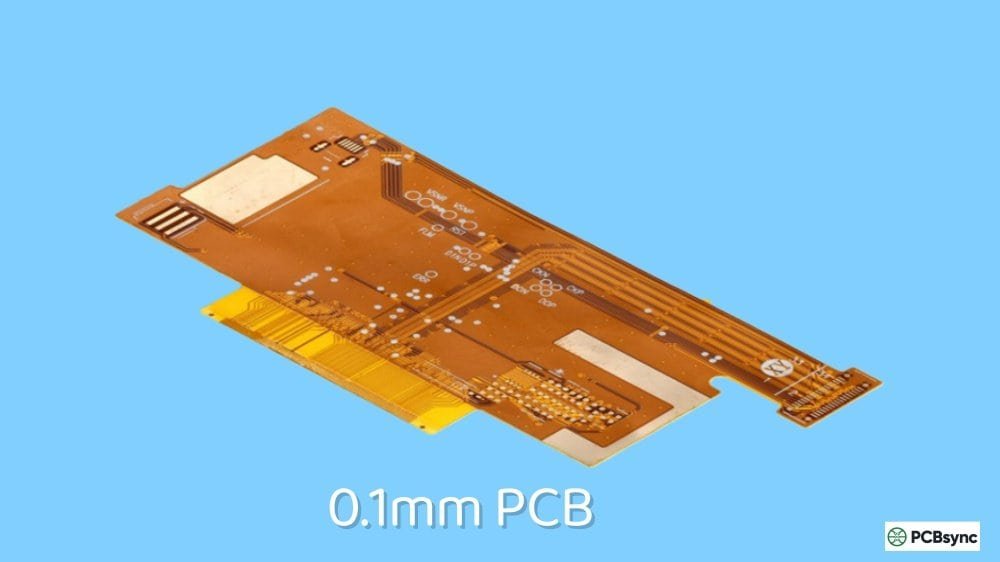
A 0.1mm PCB refers to a printed circuit board with a total thickness of approximately 0.1 millimeters (100 micrometers or about 0.004 inches). To put this in perspective, standard PCB thickness ranges from 1.0mm to 2.0mm, making a 0.1mm board roughly 10 to 20 times thinner than what most engineers work with day-to-day.
The PCB industry generally classifies board thickness into three categories:
Classification
Thickness Range
Common Applications
Standard PCB
1.0mm – 2.0mm
Consumer electronics, industrial controls
Thin PCB
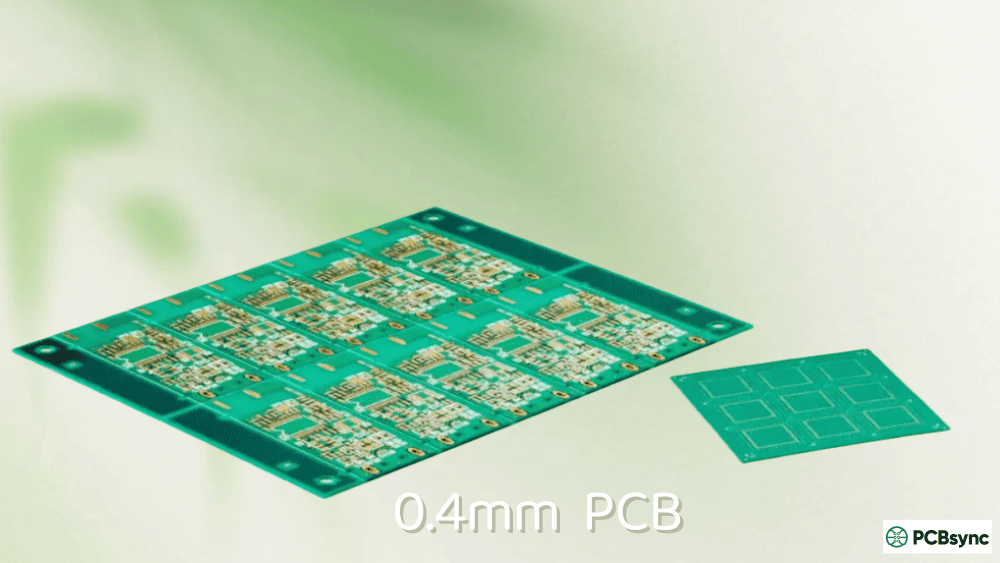
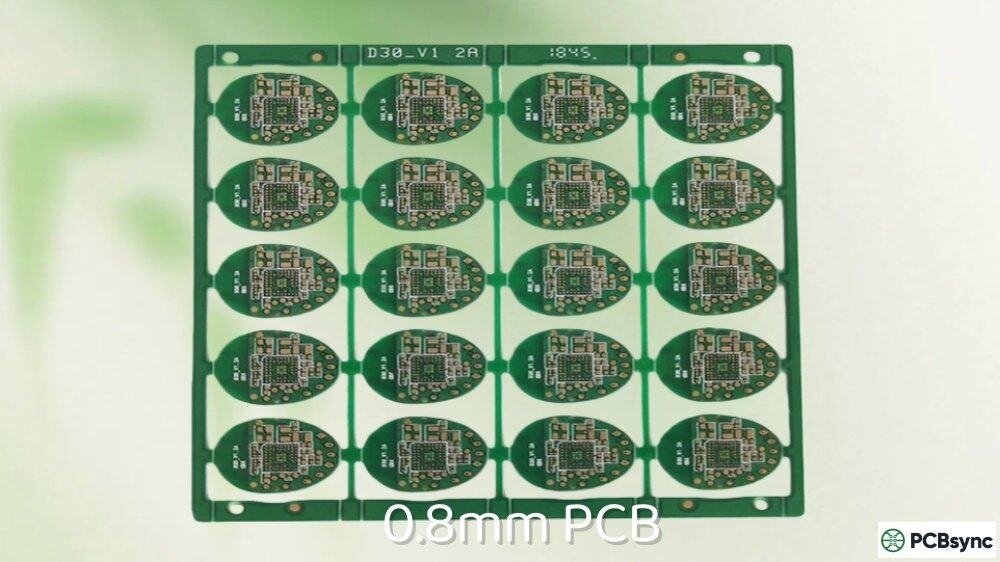
0.4mm – 0.8mm
Laptops, tablets, smartphones
Ultra-Thin PCB
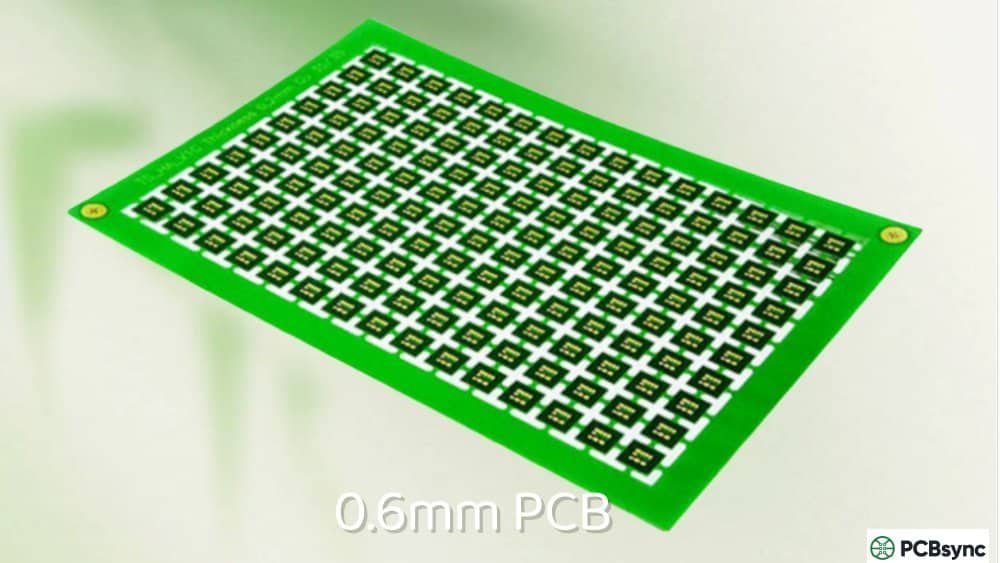
0.1mm – 0.4mm
Wearables, medical devices, IoT sensors
At the 0.1mm threshold, you’re essentially working with the thinnest rigid PCB that most fabricators can reliably produce. Anything thinner typically requires flexible circuit materials like polyimide, which behaves quite differently during manufacturing and assembly.
0.1mm PCB Materials and Substrate Options
Material selection becomes critical at this thickness. The substrate you choose directly affects mechanical stability, thermal performance, signal integrity, and manufacturability.
FR4 for 0.1mm PCB
FR4 remains the most common substrate for ultra-thin rigid boards. At 0.1mm thickness, FR4 can actually bend like a flexible circuit, though it lacks the repeated flex durability of true FPC materials. The key specifications to watch:
Property
FR4 Ultra-Thin Spec
Dielectric Constant (Dk)
4.4 – 4.8 at 1MHz
Glass Transition (Tg)
130°C – 170°C
Thermal Conductivity
~0.3 W/m·K
CTE (Z-axis)
45-65 ppm/°C
For boards that will experience any bending, specify high-Tg FR4 (170°C+) to prevent delamination during thermal cycling.
Polyimide (PI) for 0.1mm PCB
When your design requires genuine flexibility or must survive repeated bending cycles, polyimide becomes the go-to choice. Polyimide-based 0.1mm PCBs can handle bend radii as tight as 1mm (following the 10:1 rule—bend radius should be at least 10x the board thickness).
Property
Polyimide Spec
Dielectric Constant (Dk)
3.4 – 3.5
Temperature Range
-200°C to +260°C
Flex Life
100,000+ cycles
Moisture Absorption
1.3% – 2.8%
The lower Dk makes polyimide better suited for high-frequency applications above 1GHz, though the higher moisture absorption requires protective coatings in humid environments.
BT Resin (Bismaleimide Triazine) for 0.1mm PCB
For advanced packaging, IC substrates, and high-frequency designs above 5GHz, BT resin offers superior electrical properties:
Property
BT Resin Spec
Dielectric Constant (Dk)
3.0 – 3.5
Loss Tangent (Df)
0.003 – 0.005
Tg
180°C – 250°C
CTE (Z-axis)
40-50 ppm/°C
The tradeoff is cost—BT materials typically run 2-3x the price of equivalent FR4.
Manufacturing Process for 0.1mm PCB
Fabricating a 0.1mm PCB requires specialized equipment and tighter process controls than standard board production. Having toured several facilities that specialize in ultra-thin boards, I can share what happens differently and why it matters for your design decisions.
Lamination and Material Handling
At 0.1mm, the laminate is extremely fragile. Most fabricators limit stacking during drilling to 12 boards maximum (versus 24+ for standard thickness). Vacuum-assisted handling systems prevent warping, and temperature-controlled storage becomes mandatory to prevent moisture absorption that causes delamination.
The lamination process itself requires careful pressure control. Too much pressure can squeeze out resin and create voids; too little leaves weak bonds between layers. Fabricators typically use dedicated thin-board press platens with more precise pressure distribution than standard equipment.
Process Parameter
Standard PCB
0.1mm PCB
Lamination Pressure
200-350 PSI
150-250 PSI
Maximum Panel Stack
24-36 boards
10-12 boards
Storage Humidity
<50% RH
<30% RH
Handling
Standard conveyors
Vacuum fixtures
Drilling Constraints
Mechanical drilling creates stress concentrations that can crack ultra-thin substrates. The practical limits for 0.1mm PCB:
Parameter
0.1mm PCB Limit
Minimum Via Diameter
0.15mm – 0.2mm
Minimum PTH Diameter
0.2mm
Aspect Ratio (depth:diameter)
1:1 maximum
For vias smaller than 0.15mm, laser drilling becomes necessary, adding cost but enabling higher routing density. CO2 lasers work well for larger microvias (0.1mm+), while UV lasers handle the finest features (down to 0.025mm) at higher cost.
One often-overlooked issue: drill wander. On thin substrates, drill bits can deflect more easily, causing hole position errors that compound across the board. Specify tighter drill tolerances (±0.05mm rather than the standard ±0.1mm) for fine-pitch component locations.
Imaging and Etching
Photo-imaging ultra-thin panels requires careful handling to prevent scratches on the photoresist. Direct imaging (LDI) systems work better than film-based contact printing because they eliminate mechanical contact with the panel surface.
Etching thin copper presents its own challenges. The standard spray-etch process can create uneven copper distribution if the panel flexes during etching. Better fabricators use horizontal conveyorized etching with panel support systems to maintain flatness.
Surface Finish Selection
Standard HASL (Hot Air Solder Leveling) is generally too aggressive for 0.1mm boards—the thermal shock and mechanical stress during the leveling process can cause warping. Better options include:
Surface Finish
Thickness
Best For
ENIG (Electroless Nickel Immersion Gold)
3-6μm Ni, 0.05-0.1μm Au
Fine-pitch components, wire bonding
ENEPIG
3-6μm Ni, 0.05-0.15μm Pd, 0.03-0.05μm Au
Multi-purpose, gold wire bonding
OSP (Organic Solderability Preservative)
0.2-0.5μm
Cost-sensitive, short shelf life acceptable
Immersion Silver
0.15-0.4μm
Low-profile, good solderability
Immersion Tin
0.8-1.2μm
Cost-effective, lead-free compatible
ENIG remains the most common choice for 0.1mm PCB due to its flat surface profile and compatibility with fine-pitch BGA and QFN packages. However, be aware of “black pad” issues with ENIG on very fine-pitch designs—the nickel layer can develop corrosion that weakens solder joints. ENEPIG addresses this with the palladium barrier layer but costs 15-20% more.
Quality Testing
Ultra-thin boards require modified testing procedures. Flying probe testing works well for prototypes, but the probes can actually flex the board and cause false failures if the support fixtures aren’t designed for thin substrates. Production volumes typically justify dedicated test fixtures with vacuum hold-down.
Automated optical inspection (AOI) systems may need recalibration for thin boards because the reduced board thickness changes the focal plane and can cause false defect detection. Work with your fabricator to validate their AOI settings on your specific design.
Designing for ultra-thin boards requires adjustments to standard PCB practices. These guidelines come from production experience, not just theory.
Trace Width and Spacing
The minimum practical values depend on your fabricator’s capabilities, but typical limits for 0.1mm PCB production:
Feature
Minimum Value
Recommended Value
Trace Width
0.075mm (3 mil)
0.1mm (4 mil)
Trace Spacing
0.075mm (3 mil)
0.1mm (4 mil)
Annular Ring
0.1mm
0.125mm
Pushing to the absolute minimums increases cost and reject rates. Unless component density absolutely demands 3-mil traces, stay at 4-mil or wider.
Layer Count Considerations
Ultra-thin boards can support multiple layers, but thickness limits stack-up options:
Layer Count
Minimum Total Thickness
Typical Core/Prepreg
1 Layer
0.05mm
0.05mm core
2 Layer
0.1mm
0.075mm core
4 Layer
0.3mm
0.05mm cores, 0.05mm prepreg
6 Layer
0.5mm
0.05mm cores, 0.038mm prepreg
For a true 0.1mm finished thickness, you’re realistically limited to single-sided or simple double-sided constructions.
Copper Weight Selection
Thinner substrates can support limited copper weights before internal stress causes warping:
Copper Weight
Thickness
Current Capacity (10°C rise)
0.5 oz
17μm
~1A per mm trace width
1 oz
35μm
~2A per mm trace width
2 oz
70μm
Generally not recommended for 0.1mm
Most 0.1mm PCB designs use 0.5oz or 1oz copper. Heavier copper increases internal stress and makes the board more prone to warping.
Bend Area Design
If your 0.1mm PCB will experience any bending (even one-time installation bending), follow these practices:
Route traces perpendicular to the bend axis, not parallel
Use curved trace transitions, not 90-degree angles, in bend zones
Avoid vias in bend areas—they create stress concentration points
Add stiffeners to non-bend regions where components mount
Specify rolled-annealed copper instead of electrodeposited for flex zones
0.1mm PCB Applications
Ultra-thin PCBs have become essential across multiple industries where space and weight constraints drive design decisions. Let me walk you through the major application areas where I’ve seen 0.1mm technology deployed successfully.
Wearable Technology
Smartwatches, fitness trackers, and smart rings require PCBs that conform to curved enclosures while minimizing weight. A typical smartwatch main board might measure 25mm x 35mm x 0.3mm, with 0.1mm flex sections connecting to the display and sensors.
The key design considerations for wearable 0.1mm PCB include:
Requirement
Typical Specification
Total Board Weight
< 2g for ring devices, < 5g for watch modules
Bend Radius
3-5mm for band connections
Operating Temperature
0°C to 45°C (body contact)
Power Consumption
< 10mW average for week-long battery life
Fitness bands particularly benefit from ultra-thin construction because the PCB must wrap around the wrist without creating uncomfortable pressure points. I’ve worked on projects where moving from 0.4mm to 0.15mm board thickness made the difference between a wearable that users tolerated and one they actually wanted to wear.
Medical Devices
Implantable devices, glucose monitors, and hearing aids demand ultra-thin circuits that can operate reliably against skin or inside the body. Medical-grade 0.1mm PCBs typically require:
Biocompatible surface finishes (gold or parylene coating)
ISO 10993 certified materials for cytotoxicity and sensitization
Extended flex life testing (100,000+ cycles minimum)
Hermetic sealing compatibility for implantables
Traceable lot control through entire manufacturing
Continuous glucose monitors (CGMs) represent one of the highest-volume medical applications for ultra-thin PCBs. These devices must maintain intimate skin contact while housing sensors, wireless transmitters, and power management in a patch smaller than a coin. The conformable nature of 0.1mm substrates allows more accurate sensor readings by eliminating air gaps between the device and skin.
IoT Sensors and Edge Devices
Environmental monitors, asset trackers, and smart home sensors often embed 0.1mm PCBs directly into product housings or encapsulants. The thin profile allows placement in locations impossible for standard boards—inside structural members, within packaging materials, or bonded directly to monitored surfaces.
The emerging 5G IoT ecosystem places additional demands on ultra-thin PCB design:
5G IoT Requirement
Design Impact
mmWave Antenna Integration
Low-loss substrate materials (Dk < 3.5)
High Data Rates
Controlled impedance traces, differential pairs
Edge Computing
Thermal management for onboard processing
Battery Life
Ultra-low-power sleep modes, energy harvesting
Smart city infrastructure increasingly relies on networked sensors using ultra-thin PCB technology. Traffic monitors, air quality sensors, and structural health monitoring systems all benefit from the ability to embed electronics in previously impossible locations.
SIM Cards and Smart Cards
The familiar credit card-sized form factor uses ultra-thin PCB substrates (typically 0.1mm to 0.2mm) bonded to plastic carriers. These applications demand exceptional dimensional stability and resistance to mechanical stress from repeated insertion and flexing in wallets.
Aerospace and Defense
Weight savings matter enormously in aerospace. Ultra-thin PCBs in satellites and aircraft can reduce payload weight while maintaining reliability under extreme thermal cycling and vibration. Every gram saved in satellite electronics translates to either reduced launch costs or capacity for additional functionality.
Defense applications often combine ultra-thin PCBs with rigid-flex construction to create electronics that conform to weapon system geometries while surviving severe shock and vibration environments.
Challenges and Limitations of 0.1mm PCB
Working with ultra-thin boards introduces engineering challenges that don’t exist with standard thickness. Having run into these issues on multiple projects, I want to share what actually goes wrong and how to prevent it.
Mechanical Fragility
A 0.1mm board can snap if mishandled during manufacturing, assembly, or testing. Fabricators and assemblers need specialized fixturing and trained operators. Expect higher handling-related reject rates until your supply chain develops appropriate procedures.
The most common failure modes I’ve encountered:
Failure Mode
Cause
Prevention
Corner cracking
Rough handling during depanelization
Use routed edges, not V-score
Mid-board fracture
Unsupported flex during transport
Vacuum fixtures, rigid carriers
Delamination
Moisture absorption before reflow
Bake boards before assembly
Warping
Uneven copper distribution
Balance copper on both sides
For prototype quantities, specify that boards ship in rigid ESD containers rather than standard pink bags. The few extra dollars in packaging prevents expensive remake cycles.
Thermal Management
Thin substrates have limited thermal mass and poor heat spreading. Components that would run cool on a 1.6mm board may overheat on a 0.1mm design. I’ve seen components derate by 30-40% simply due to the substrate change, even with identical power dissipation.
Consider these thermal design approaches:
Thermal vias under hot components (even small ones help)
External heat sinks or thermal interface materials
Power derating for thermally sensitive components
Spreading heat to larger copper areas away from components
Adding metal stiffeners that double as heat spreaders
For wearable applications against skin, thermal management becomes even more critical—component temperatures that would be acceptable in a ventilated enclosure may cause user discomfort or regulatory compliance issues when placed against the body.
Assembly Complications
SMT assembly of 0.1mm boards requires adjusted reflow profiles and specialized fixtures. The low thermal mass means boards heat up faster than standard profiles expect, potentially causing component damage or solder defects. Work with your assembler early to validate profiles.
Specific assembly challenges include:
Assembly Step
Challenge
Solution
Stencil Printing
Board deflection during printing
Vacuum hold-down fixtures
Pick and Place
Board movement during placement
Dedicated thin-board pallets
Reflow
Rapid heating, board curl
Reduced ramp rate, edge support
Inspection
Difficult to fixture for AOI
Custom carriers with fiducial windows
Many contract manufacturers charge premium rates for ultra-thin board assembly—typically 20-40% above standard assembly pricing—to cover the additional setup and handling time required.
Signal Integrity
Thin dielectrics between layers change impedance characteristics significantly. Controlled impedance designs require careful stack-up engineering and may need wider traces to achieve target impedance values.
For a 50-ohm microstrip on 0.1mm FR4 substrate with 1oz copper, you’ll typically need trace widths around 0.18mm—significantly wider than the 0.1mm traces possible on thicker substrates. This consumes routing real estate and can force designs to additional layers.
High-frequency designs above 1GHz face additional challenges with ultra-thin FR4 due to its relatively high loss tangent (Df around 0.02). For RF applications, consider low-loss materials like Rogers or specialty polyimides, though these add substantial cost.
How to Order 0.1mm PCB: Specifications Checklist
When requesting quotes for ultra-thin boards, provide these specifications explicitly:
Parameter
What to Specify
Total Thickness
0.1mm ±0.05mm (typical tolerance)
Material
FR4, Polyimide, BT resin
Layer Count
1L, 2L, etc.
Copper Weight
0.5oz, 1oz
Surface Finish
ENIG, OSP, Immersion Silver
Minimum Trace/Space
0.1mm/0.1mm
Via Type
Mechanical, laser, blind/buried
Solder Mask
LPI, PSR, specify color
Flex Requirements
Static bend, dynamic flex, bend radius
Testing
Flying probe, fixture, AOI requirements
Useful Resources for 0.1mm PCB Design
These references provide additional technical depth:
IPC Standards:
IPC-2221B: Generic Standard on Printed Board Design
IPC-2223: Sectional Design Standard for Flexible Printed Boards
IPC-6013: Qualification and Performance Specification for Flexible Printed Boards
What is the thinnest PCB that can be manufactured?
Most fabricators can reliably produce rigid PCBs down to 0.1mm thickness using FR4 or similar materials. For thinner constructions (0.05mm-0.08mm), flexible polyimide substrates are typically required. Single-layer flexible circuits can reach 0.05mm total thickness, though handling and assembly become extremely challenging at these dimensions.
Can 0.1mm PCB be used for multilayer designs?
True 0.1mm total thickness limits you to single or double-sided designs. However, the term “0.1mm PCB” sometimes refers to ultra-thin multilayer boards in the 0.3mm-0.4mm range built with 0.1mm cores. If you need multiple routing layers, expect minimum finished thickness around 0.3mm for 4-layer and 0.5mm for 6-layer constructions.
What is the difference between 0.1mm PCB and flexible PCB?
A 0.1mm FR4 PCB can bend once during installation but isn’t designed for repeated flexing—it will eventually crack. True flexible PCBs use polyimide substrates specifically engineered for dynamic flex applications, capable of 100,000+ bend cycles. Choose flexible PCB when your application requires ongoing movement; choose ultra-thin FR4 when you need a thin but essentially static board.
How much does 0.1mm PCB cost compared to standard PCB?
Expect 30-50% higher per-board costs compared to equivalent 1.6mm designs, primarily due to material handling requirements, lower panel utilization, and tighter process controls. Prototype quantities may show even higher premiums (2-3x) because fabricators must dedicate specialized equipment and processes. Volume production amortizes setup costs and narrows the gap.
What surface finish is best for 0.1mm PCB?
ENIG (Electroless Nickel Immersion Gold) is the most common choice for 0.1mm PCB because it provides a flat, uniform surface compatible with fine-pitch components while adding minimal thickness. OSP works well for cost-sensitive applications with short time-to-assembly, while immersion silver offers good solderability at lower cost than ENIG. Avoid HASL for ultra-thin boards—the process can cause warping.
Conclusion
Designing and manufacturing 0.1mm PCB successfully requires understanding the constraints that come with ultra-thin substrates. The material behaves differently, the manufacturing tolerances are tighter, and the assembly process needs adaptation. But when your application demands minimal thickness—whether for wearables, medical devices, or space-constrained IoT sensors—mastering these techniques opens up design possibilities that simply don’t exist with standard PCB technology.
Start by selecting the right substrate for your bending requirements and environmental conditions. Design conservatively on trace widths and via sizes until you’ve validated your fabricator’s capabilities. And engage your PCB manufacturing partners early—the successful 0.1mm PCB designs I’ve seen all involved close collaboration between design, fabrication, and assembly teams from the beginning.
Inquire: Call 0086-755-23203480, or reach out via the form below/your sales contact to discuss our design, manufacturing, and assembly capabilities.
Quote: Email your PCB files to Sales@pcbsync.com (Preferred for large files) or submit online. We will contact you promptly. Please ensure your email is correct.
Notes: For PCB fabrication, we require PCB design file in Gerber RS-274X format (most preferred), *.PCB/DDB (Protel, inform your program version) format or *.BRD (Eagle) format. For PCB assembly, we require PCB design file in above mentioned format, drilling file and BOM. Click to download BOM template To avoid file missing, please include all files into one folder and compress it into .zip or .rar format.